
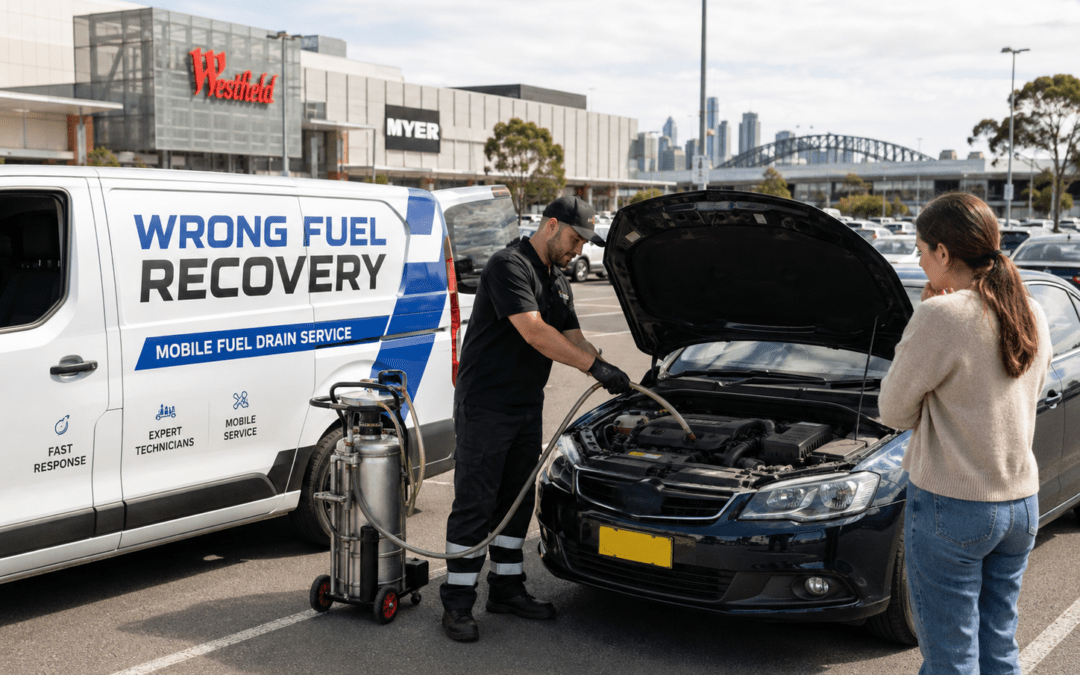
Emergency Wrong Fuel Recovery at Shopping Centres: What to Do
Putting the wrong fuel in your car can be stressful.
However, a shopping centre can make the situation more difficult.
For example, your car may be inside an underground car park.
It may also be parked on a busy level or near an exit.
If you notice the mistake, keep the engine off.
Therefore, do not drive the car to another parking area.
Instead, contact shopping-centre security and a wrong fuel recovery service.
What Should You Do Immediately?
If you notice the mistake, act as soon as possible.
First, keep the engine switched off.
Next, avoid turning the ignition on.
Then, contact shopping-centre security.
After that, contact a wrong fuel recovery technician.
Also, provide your exact parking location.
Finally, stay available by phone.
If the engine is already running, find a safe place to stop.
Then, switch the engine off.
Do Not Drive Out of the Car Park
You may want to drive to the exit.
However, this can make the problem worse.
For example, the wrong fuel may move through the fuel system.
In addition, the car may stop on a ramp or near a boom gate.
Therefore, do not drive to:
- The shopping-centre exit
- Another parking level
- A nearby mechanic
- A nearby petrol station
- The roadside
- Your home
Instead, wait for professional advice.
Contact Shopping-Centre Security
Shopping-centre staff can help manage the area.
Therefore, tell security as soon as possible.
This is especially important if the car is:
- Blocking a lane
- Parked on a ramp
- Near an entrance
- Near an exit
- At a boom gate
- Inside an underground level
- In a loading area
- In an accessible bay
- Leaking fuel
Security may also help the technician enter the site.
For example, they may provide the correct entrance.
In addition, they may confirm the parking level and bay.
They may also open a secure gate.
Therefore, always tell security that a technician is coming.
Turn On Your Hazard Lights When Needed
Use your hazard lights if the car blocks traffic.
Also, use them if other drivers may not expect your vehicle to stop there.
However, do not remain in a dangerous traffic lane.
Instead, follow the instructions from shopping-centre security.
Keep Your Parking Ticket
The recovery process may take time.
Therefore, keep your parking ticket.
Also, tell centre management about the problem.
For example, they may explain whether parking fees can be adjusted.
However, parking rules vary between centres.
Therefore, do not assume the fee will be cancelled.
Keep Your Fuel Receipt
Your fuel receipt can provide useful information.
For example, it may show:
- Fuel type
- Amount added
- Service station
- Pump number
- Date
- Time
Also, take a photo of the receipt.
That way, you still have a copy if the paper is lost.
What Information Should You Give the Technician?
Provide clear information when you call.
For example, give:
- Shopping-centre name
- Street address
- Car-park entrance
- Parking level
- Bay number
- Nearest store
- Nearest lift
- Height clearance
- Vehicle make
- Vehicle model
- Correct fuel type
- Wrong fuel added
- Amount added
- Whether you started the engine
- Distance driven
- Current symptoms
In addition, tell the technician if fuel is leaking.
This information helps them plan the recovery.
Therefore, provide as much accurate information as possible.
What If You Notice the Mistake Before Entering the Centre?
Do not drive to the shopping centre.
Instead, keep the vehicle where it is.
Then, tell petrol station staff about the mistake.
After that, contact a wrong fuel recovery service.
Driving the vehicle can spread the wrong fuel.
Therefore, keep the engine off when possible.
What If Symptoms Start Inside the Shopping Centre?
Some vehicles may continue driving for a short time.
However, symptoms can appear later.
For example, you may notice:
- Loss of power
- Rough running
- Engine hesitation
- Misfiring
- Smoke
- Warning lights
- Difficulty restarting
- Engine shutdown
If these signs appear, stop safely.
Then, switch the engine off.
After that, contact security and a technician.
Can Mobile Fuel Drainage Be Done in a Shopping Centre?
In many cases, yes.
However, the technician must first check the location.
Several factors can affect the service.
For example, they may check:
- Ventilation
- Parking height
- Vehicle access
- Working space
- Centre permission
- Pedestrian traffic
- Fuel-spill risk
- Vehicle condition
Therefore, mobile recovery is not possible in every car park.
Open-Air Shopping-Centre Car Parks
Open-air areas may provide easier access.
For example, they often have more ventilation.
They may also provide more working space.
However, the car park is still private property.
Therefore, the technician may need permission.
Provide:
- Parking row
- Bay number
- Nearest store
- Entrance location
- Nearby landmark
Also, send a photo if needed.
Multi-Storey Car Parks
Multi-storey car parks can create extra problems.
For example, the service vehicle may be too tall.
Therefore, provide the height clearance before dispatch.
Also, tell the technician:
- Parking level
- Ramp width
- Entrance location
- Turning space
- Ticket requirements
- Loading entrance details
Do not drive the contaminated car down several levels.
Instead, wait for instructions.
Underground Shopping-Centre Car Parks
Underground car parks need extra care.
Petrol vapour can collect in poorly ventilated areas.
Therefore, fuel work may not be suitable in every underground location.
The technician may need another option.
For example:
- Work in the current bay
- Use portable equipment
- Move the car manually
- Use a loading area
- Tow the car outside
- Take the car to a workshop
Therefore, provide the parking height and ventilation details early.
What If There Is a Fuel Leak?
A fuel leak needs more caution.
First, keep the vehicle off.
Next, keep people away.
Also, avoid smoking or open flames.
Do not wash fuel into a drain.
Then, contact shopping-centre security.
If there is immediate danger, call Triple Zero.
Therefore, treat visible fuel leaks as a safety issue.
What If You Smell Strong Petrol Fumes?
Move away from the immediate area.
Then, tell security.
Also, avoid unnecessary ignition sources.
If the smell is very strong, follow emergency instructions.
Do not begin DIY fuel removal.
Instead, wait for trained assistance.
Should You Push the Vehicle?
Sometimes, a car can be pushed.
However, this should only happen when it is safe.
For example, consider:
- Vehicle weight
- Ground slope
- Parking brake
- Steering lock
- Traffic
- Pedestrians
- Transmission type
Never release the brake on a ramp without help.
Therefore, follow security or technician instructions.
What If the Car Blocks a Boom Gate?
Contact security immediately.
Do not restart the car to move a few metres.
Instead, centre staff may redirect traffic.
They may also open another lane.
In addition, they may help arrange safe vehicle movement.
Therefore, explain that driving may cause further problems.
What If the Car Is in an Accessible Bay?
Tell security that the car cannot move.
Also, explain that professional help is coming.
Do not drive the car simply to free the bay.
Instead, ask security for guidance.
What If Children or Pets Are With You?
Move passengers to a safe waiting area.
For example, use:
- Customer service
- Seating areas
- Parent rooms
- Accessible facilities
Do not leave children or pets alone in the car.
Therefore, arrange a safe place while you wait.
How Can the Technician Find You Faster?
Shopping centres can cover a large area.
Therefore, a normal street address may not be enough.
Provide:
- Centre name
- Street entrance
- Parking level
- Section
- Bay number
- Nearest lift
- Nearest store
- Vehicle colour
- Vehicle registration
In addition, send a location pin.
A photo of nearby signs can also help.
Will the Shopping Centre Allow Fuel Removal?
This depends on centre rules.
For example, management may ask for:
- Business identification
- Insurance details
- Equipment details
- Contractor documents
- Spill-control information
Therefore, contact security before the technician arrives.
Permission can save time.
Mobile Fuel Drain or Tow Truck?
A mobile drain may work when the car is safely parked.
For example, mobile recovery may suit a car with good access.
It may also work when there is no fuel leak.
However, towing may be better in other cases.
For example, towing may be needed when:
- The car is on a ramp
- Fuel is leaking
- The area has poor ventilation
- The technician cannot enter
- Management refuses the work
- The engine stopped
- Heavy smoke appeared
- Warning lights remain
Therefore, the technician should assess the situation first.
How Long Can Recovery Take?
There is no single recovery time.
For example, access can affect the process.
In addition, underground parking can cause delays.
The total time may include:
- Finding the correct entrance
- Getting security approval
- Reaching the vehicle
- Checking the fuel
- Draining the tank
- Flushing the system
- Adding clean fuel
- Testing the vehicle
Therefore, provide clear location details early.
How Much Does Shopping-Centre Recovery Cost?
The price can vary.
For example, location can affect the cost.
Other factors include:
- Time of day
- Parking fees
- Vehicle type
- Fuel amount
- Distance driven
- System flushing
- Replacement fuel
- Towing
- Workshop inspection
Therefore, ask for the cost before work begins.
Can Roadside Assistance Help?
Roadside assistance may help.
However, services vary by membership.
Tell them that the car contains the wrong fuel.
Do not only say that the vehicle will not start.
Also, ask whether they cover:
- Towing
- Fuel drainage
- Underground access
- Workshop transport
Therefore, provide full details when you call.
Can Insurance Cover Wrong Fuel?
Some policies may cover misfuelling.
However, others may exclude it.
Therefore, contact your insurer.
Ask whether the policy covers:
- Fuel removal
- Vehicle damage
- Towing
- Workshop work
- Recovery fees
Also, keep your receipts and reports.
What Should You Avoid Doing?
After discovering the wrong fuel, avoid these actions:
- Do not start the engine.
- Do not drive to another bay.
- Do not drive to the exit.
- Do not dilute the fuel.
- Do not siphon the tank yourself.
- Do not open fuel lines.
- Do not pour fuel into a drain.
- Do not smoke nearby.
- Do not ignore a leak.
- Do not hide how far you drove.
Therefore, wait for professional guidance.
Frequently Asked Questions
Can Wrong Fuel Be Drained in an Underground Car Park?
Possibly.
However, the technician must check ventilation and access.
In addition, centre management may need to approve the work.
Therefore, the car may need to move outside.
Should I Drive to the Shopping-Centre Exit?
No.
Driving may spread the wrong fuel.
Instead, keep the engine off.
Then, contact security and a technician.
What If My Car Blocks Other Vehicles?
First, switch on the hazard lights.
Then, contact shopping-centre security.
They may redirect traffic.
Therefore, do not restart the engine just to move the car.
Can a Technician Enter a Ticketed Car Park?
Often, yes.
However, access rules vary.
Therefore, provide the entrance and ticket details.
Will I Pay Extra Parking Fees?
Possibly.
Ask centre management about the parking ticket.
However, the recovery provider cannot control parking fees.
What If I Smell Strong Petrol Fumes?
Move away from the immediate area.
Then, contact security.
If there is immediate danger, call Triple Zero.
Can I Keep Shopping While I Wait?
Stay contactable.
The technician may need you at the car.
Therefore, follow security instructions.
What If the Car Is on a Ramp?
Do not push it without help.
Instead, contact security.
Then, arrange professional recovery.
Will a Tow Truck Fit Inside the Car Park?
Not always.
Height limits and turning space can cause problems.
Therefore, provide those details before dispatch.
Can Mobile Recovery Help If I Already Drove?
Yes, the technician may still help.
However, the car may need extra flushing or inspection.
Therefore, explain how far you drove.
Need Wrong Fuel Recovery at a Sydney Shopping Centre?
If you put the wrong fuel in your car, keep the engine off.
Then, contact shopping-centre security.
After that, contact a professional recovery service.
Also, provide your exact parking location.
Finally, mention any fuel leak or strong smell.
Mobile wrong fuel recovery may be available at suitable Sydney shopping centres.

Misfuelling can feel overwhelming, especially at a busy Sydney service station. Staying calm is crucial. Panic often leads to quick decisions like starting the engine to move the car or tapping the accelerator to “check” if it runs properly. Even a few seconds of operation can push contaminated fuel deeper into the system. Pause, breathe, and avoid making the situation worse.
If the engine has already been started, switch it off immediately. Do not restart it under any circumstances. Keeping the ignition completely off prevents the fuel pump from circulating contaminated fuel through the injectors and fuel lines. The less movement inside the system, the lower the risk of damage.

Call Wrong Fuel Recovery & Mobile Mechanic or you can book online for immediate assistance.
Once help is on the way, there is nothing more you need to do. Our team at Wrong Fuel Recovery and Mobile Mechanic typically arrives quickly across Sydney and surrounding NSW suburbs. Using specialised equipment, they safely drain the contaminated fuel and refill your vehicle with the correct type, restoring normal operation without unnecessary stress on the engine.
Acting calmly and quickly makes all the difference. In most cases, these four simple steps turn a stressful moment into a manageable situation.
Across Sydney and surrounding suburbs in NSW, fast response is the key difference between a minor inconvenience and a costly repair. Timing truly is everything after misfuelling. The sooner the engine is switched off and contaminated fuel is removed, the greater the chance your vehicle returns to normal without lasting damage.
A small mistake at the pump does not have to become a long term problem. With prompt wrong fuel rescue, drivers across Sydney can protect their engines, reduce repair costs, and get back on the road with confidence.