
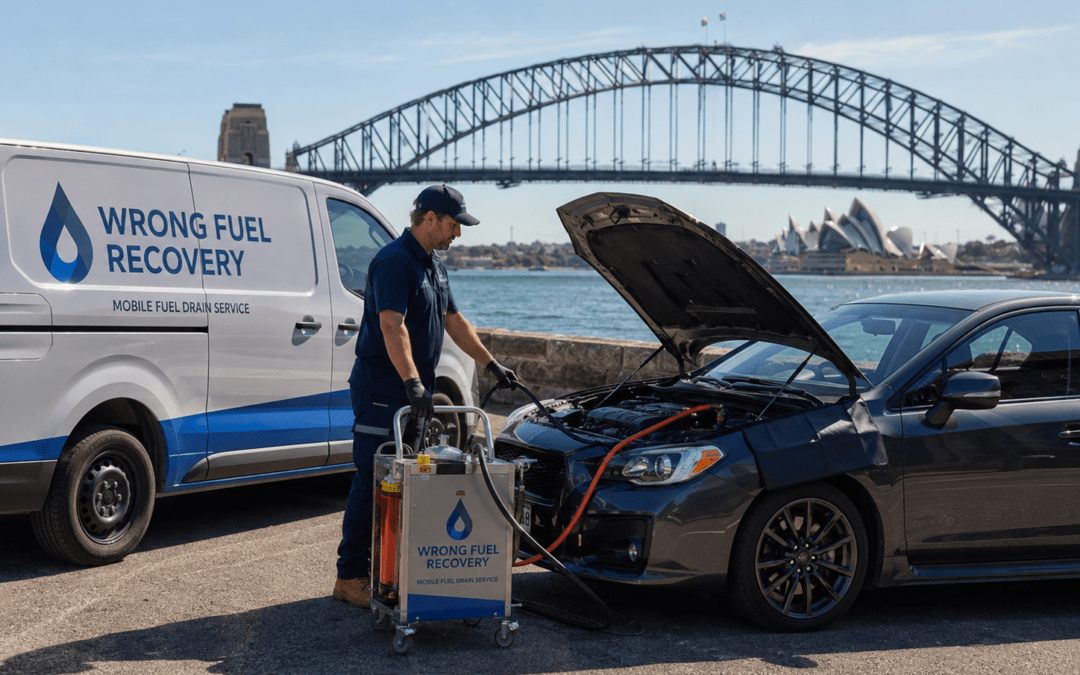
How long does a fuel drain take? Learn the usual wrong fuel recovery timeline, what can delay the process and how quickly Sydney drivers can get moving.
How Long Does a Fuel Drain Take After Putting the Wrong Fuel in Your Car?
After putting the wrong fuel in your vehicle, one of the first questions you may ask is:
How long does a fuel drain take?
In a straightforward case, the actual draining and recovery process may take approximately 30 to 60 minutes after the technician begins working. However, this is only a general guide. Some vehicles can be completed more quickly, while complicated cases may take longer.
Professional fuel-drain services report different completion times depending on the vehicle and situation. One roadside fuel-drain provider states that many jobs take less than 30 minutes, while the AA’s specialist service says it can often return drivers to the road in around 30 minutes after arrival. These estimates should not be treated as a guarantee for every vehicle.
The total time from your first phone call until you are moving again also includes:
- The technician’s travel time
- Initial vehicle assessment
- Fuel extraction
- Flushing when required
- Adding the correct fuel
- Testing the vehicle
- Further inspection when damage is suspected
Wrong Fuel Recovery & Mobile Mechanic currently aims to reach customers in Sydney and surrounding suburbs within approximately 30–60 minutes, depending on location. This arrival estimate is separate from the time required to perform the fuel drain.
What is the average wrong fuel drain time?
For a vehicle that has not been started or driven, a straightforward mobile fuel drain may commonly take around 30–60 minutes once work begins.
This usually involves:
- Confirming what fuel was added
- Accessing the fuel tank
- Removing the contaminated mixture
- Flushing relevant parts where necessary
- Adding clean fuel
- Checking whether the vehicle starts and operates normally
The procedure may take longer if the incorrect fuel has travelled beyond the tank or the vehicle has a complicated fuel-system design.
There are therefore two different times to consider:
Technician arrival time
This is the period between your request for assistance and the technician arriving at your location.
Wrong Fuel Recovery & Mobile Mechanic states that it aims to attend within 30–60 minutes, depending on the customer’s location in Sydney and the surrounding suburbs.
Fuel-drain service time
This begins when the technician assesses and starts working on the vehicle.
The service time depends on the amount of contaminated fuel, vehicle design, whether the engine was started and whether further checks are required.
When asking for assistance, request an estimate for both the arrival time and the time required to complete the job.
What happens during a professional fuel drain?
A professional fuel drain involves more than simply inserting a hose into the tank.
The technician first needs to understand exactly what happened so that the safest procedure can be selected.
Step 1: Assessing the incident
The technician may ask:
- What fuel does the vehicle normally use?
- What incorrect fuel was added?
- Approximately how many litres were added?
- Was the ignition switched on?
- Was the engine started?
- Was the vehicle driven?
- Did any warning lights appear?
- Did the engine misfire, smoke or lose power?
This assessment helps determine whether the contamination is likely to be limited to the tank or may have travelled through other parts of the fuel system.
Step 2: Accessing the fuel
Fuel tanks differ between vehicles. Some are easier to access, while others have:
- Anti-siphon devices
- Narrow filler necks
- Multiple tank compartments
- Internal pumps
- Restricted access points
- Complex tank shapes
The method used will therefore depend on the make, model and fuel-system design.
Step 3: Removing the contaminated fuel
The incorrect fuel and the original fuel mixed with it must be safely extracted and placed into suitable containers.
Drivers should not attempt to siphon fuel themselves. RAC advises that draining should be performed by a specialist because of the risks to the driver and the environment.
Step 4: Flushing the system when required
A flush may be needed when contaminated fuel has entered accessible fuel lines or other parts of the system.
The extent of flushing depends on:
- The fuel combination
- Whether the ignition was activated
- Whether the engine ran
- How far the vehicle travelled
- The technician’s assessment
- The manufacturer’s system design
Not every incident requires exactly the same procedure.
Step 5: Adding the correct fuel
After the contaminated mixture has been removed, clean fuel is added.
Wrong Fuel Recovery & Mobile Mechanic states that its mobile service vehicles are equipped to drain, flush and refuel vehicles on-site.
Step 6: Testing the vehicle
The technician may start the engine and monitor whether it:
- Starts normally
- Idles smoothly
- Responds correctly
- Produces unusual smoke
- Shows warning lights
- Makes unexpected noises
When the vehicle does not operate normally after drainage, further diagnostics or workshop repairs may be recommended.
What can make a fuel drain take longer?
Several factors may extend the wrong fuel recovery time.
1. The engine was started
When the engine has not been started, the incorrect fuel may remain mainly inside the tank.
Starting the engine can circulate the fuel mixture through:
- Fuel lines
- Fuel filters
- Pumps
- Injectors
- The engine
The recovery may then involve more flushing, testing and inspection.
NRMA advises drivers not to switch on the ignition after noticing a wrong-fuel mistake and explains that professional draining and possibly new filters may be needed.
2. The vehicle was driven
Driving after misfuelling can distribute contaminated fuel farther through the vehicle.
The technician may need additional time to determine whether a standard mobile drain is enough or whether the vehicle should be transported to a workshop.
Possible symptoms include:
- Loss of power
- Rough running
- Engine knocking
- Excessive exhaust smoke
- Misfiring
- Difficulty restarting
- The engine cutting out
RAC notes that a vehicle driven with petrol in a diesel system may lose power or make a knocking sound, depending on how much incorrect fuel is present.
3. The amount of fuel in the tank
Removing a nearly full tank normally takes longer than removing a smaller quantity.
The technician may need to extract:
- The wrong fuel added
- The correct fuel already in the tank
- Fuel used during flushing
- Contaminated fuel remaining in accessible lines
Tank size also varies considerably between a small passenger car, van, truck, four-wheel drive and commercial vehicle.
4. The vehicle’s fuel-system design
Modern vehicles can have complicated tank and injection systems.
A vehicle with restricted tank access or a high-pressure diesel system may require more preparation than a vehicle with a simpler design.
The technician may also need additional time when working on:
- Commercial vans
- Trucks
- Motorbikes
- Four-wheel drives
- Fleet vehicles
- Vehicles with divided tanks
- Vehicles with anti-siphon technology
Wrong Fuel Recovery & Mobile Mechanic states that it services cars, vans, trucks, motorbikes and fleet vehicles.
5. The type of fuel mistake
The recovery process may differ depending on what was placed in the tank.
Petrol in a diesel vehicle
Diesel helps lubricate parts of a diesel injection system. Petrol reduces that lubrication and may cause wear when circulated through the system.
The sooner the engine is switched off, the better the chance that the incident can be handled without more extensive work.
Diesel in a petrol vehicle
Diesel contamination may cause smoke, misfiring, loss of power, rough operation or failure to restart.
The contaminated fuel still needs to be removed, and affected parts may require flushing or inspection.
The company’s services page explains that both petrol-in-diesel and diesel-in-petrol incidents involve draining the contaminated fuel and refilling the system with clean fuel.
6. The vehicle’s location
The job may take longer when the technician has limited access to the vehicle.
Examples include:
- Underground shopping-centre parking
- Narrow residential driveways
- Busy service-station forecourts
- Road shoulders
- Secure workplaces
- Construction areas
- Height-restricted car parks
Tell the recovery provider about access restrictions before the technician travels to you.
This allows the technician to bring suitable equipment and plan the safest way to reach the vehicle.
7. Suspected mechanical damage
A fuel drain removes the contaminated fuel, but it cannot automatically reverse mechanical damage that has already occurred.
Additional time may be required for:
- Diagnostic scanning
- Fuel-filter replacement
- Pump inspection
- Injector testing
- Spark-plug inspection
- Workshop assessment
- Towing
When significant damage is suspected, the vehicle may not be ready to drive immediately after the tank has been drained.
How long will I be waiting in total?
Your total waiting time can be estimated as:
Technician travel time
 assessment time
 fuel-drain time
 flushing and refuelling time
 vehicle testing
For example, a straightforward case could involve:
- 30–60 minutes for the technician to arrive
- Approximately 30–60 minutes for the service
- A short period for testing and final checks
This could mean a total of roughly one to two hours from the first phone call, but it is only an example—not a guaranteed completion time.
Traffic, distance, vehicle type and contamination can all affect the timeline.
Wrong Fuel Recovery advertises 24/7 service throughout Sydney and surrounding NSW suburbs, with arrival depending on the customer’s location.
Can you make the fuel drain faster?
You should not rush the actual fuel-removal procedure. However, you can avoid unnecessary delays by giving the technician accurate information.
Before calling, prepare:
- Your exact location
- Vehicle make and model
- Registration year, when known
- The fuel the vehicle requires
- The incorrect fuel added
- The approximate amount added
- Whether the ignition was switched on
- Whether the engine was started
- Whether the vehicle was driven
- Any symptoms or warning lights
- Car-park access instructions
- Your contact number
You can also keep your fuel receipt because it may show the grade and amount purchased.
Most importantly, leave the engine off. Continuing to start or drive the vehicle can make the recovery more complicated.
Should I try draining the fuel myself?
No.
Petrol and diesel require careful handling, suitable extraction equipment and appropriate containers. Petrol vapour can be dangerous, and contaminated fuel should not be poured onto the ground, into drains or into ordinary waste.
RAC specifically advises drivers not to attempt siphoning and recommends using a specialist to protect both people and the environment.
A professional service is also better positioned to determine whether contamination has travelled beyond the tank.
Can a fuel drain be completed at a petrol station?
In many cases, a mobile fuel drain can be performed at or near the petrol station, provided the location is safe and the site permits the work.
When you notice the mistake before leaving the pump:
- Do not start the engine.
- Inform the petrol-station staff.
- Put the car in neutral only when it is safe and staff advise moving it.
- Ask for help pushing it away from the bowser.
- Keep the receipt.
- Call a mobile wrong fuel technician.
Do not move the vehicle by driving it to another parking space.
A mobile technician may also attend vehicles located at homes, workplaces or safe roadside locations, depending on accessibility and operating coverage.
Is towing faster than mobile fuel drainage?
Not necessarily.
Towing normally involves:
- Waiting for the tow truck
- Loading the vehicle
- Travelling to a workshop
- Waiting for workshop availability
- Performing the fuel drain
- Completing any inspection or repairs
A mobile recovery service may remove the contaminated fuel at your location, avoiding a separate trip to a workshop.
However, towing may be the safer option when:
- The vehicle has stopped while driving
- There is suspected engine damage
- The location is unsafe
- On-site work is not permitted
- Special workshop equipment is required
- The fuel system needs extensive repair
The recovery provider should advise which option is appropriate after assessing the incident.
Frequently asked questions
How long does a fuel drain take if I did not start the car?
A straightforward drain may take approximately 30–60 minutes once the technician starts working. The actual time depends on tank size, access and vehicle design.
How long does it take if I drove the car?
It may take longer because contaminated fuel may have entered the lines, filter, pump, injectors or engine. Additional flushing, testing or workshop inspection could be needed.
How quickly can a wrong fuel technician arrive in Sydney?
Wrong Fuel Recovery & Mobile Mechanic says it aims to arrive within approximately 30–60 minutes, depending on the customer’s location.
Can I drive after the fuel has been drained?
Only drive when the technician confirms that the vehicle is operating normally and safe to use. Further inspection may be required when warning lights, rough running or unusual noises remain.
Does a full tank take longer to drain?
Generally, a larger quantity requires more extraction and handling time than a small amount. Tank access and vehicle design also affect the duration.
Will the technician replace my fuel filter?
A filter may need inspection or replacement in some cases, particularly when contaminated fuel has circulated through the system. Ask what is included in the quote before work begins.
Can the vehicle be fixed where it is parked?
Many straightforward incidents can be handled by a mobile fuel-drain service at the vehicle’s location. Access, safety, vehicle condition and site rules will determine whether on-site work is appropriate.
Is the 30–60 minute estimate guaranteed?
No. It is a general guide for a straightforward job. The recovery provider should give you a more accurate estimate after receiving your vehicle and incident details.
Need a fast mobile fuel drain in Sydney?
The sooner you respond to a wrong-fuel mistake, the simpler the recovery may be.
Remember:
- Do not start the engine
- Do not continue driving
- Keep your fuel receipt
- Record how much fuel was added
- Tell the technician exactly what happened
- Arrange professional fuel removal

Misfuelling can feel overwhelming, especially at a busy Sydney service station. Staying calm is crucial. Panic often leads to quick decisions like starting the engine to move the car or tapping the accelerator to “check” if it runs properly. Even a few seconds of operation can push contaminated fuel deeper into the system. Pause, breathe, and avoid making the situation worse.
If the engine has already been started, switch it off immediately. Do not restart it under any circumstances. Keeping the ignition completely off prevents the fuel pump from circulating contaminated fuel through the injectors and fuel lines. The less movement inside the system, the lower the risk of damage.

Call Wrong Fuel Recovery & Mobile Mechanic or you can book online for immediate assistance.

Once help is on the way, there is nothing more you need to do. Our team at Wrong Fuel Recovery and Mobile Mechanic typically arrives quickly across Sydney and surrounding NSW suburbs. Using specialised equipment, they safely drain the contaminated fuel and refill your vehicle with the correct type, restoring normal operation without unnecessary stress on the engine.
Acting calmly and quickly makes all the difference. In most cases, these four simple steps turn a stressful moment into a manageable situation.
Across Sydney and surrounding suburbs in NSW, fast response is the key difference between a minor inconvenience and a costly repair. Timing truly is everything after misfuelling. The sooner the engine is switched off and contaminated fuel is removed, the greater the chance your vehicle returns to normal without lasting damage.
A small mistake at the pump does not have to become a long term problem. With prompt wrong fuel rescue, drivers across Sydney can protect their engines, reduce repair costs, and get back on the road with confidence.