
Misfuelling your car often feels like a small, embarrassing mistake — something you hope will be quick, cheap, and easy to fix. Typically, it happens when you’re distracted, rushing through a refuelling stop, or driving a rental or unfamiliar vehicle. However, the true cost of misfuelling has very little to do with embarrassment. Instead, it depends almost entirely on how quickly you act, whether the engine was started, and how far contaminated fuel travels through the fuel system.
Across Australia, misfuelling repair expenses can range from a few hundred dollars for an early fuel drain to well over $5,000 for major mechanical repairs or engine replacement. Crucially, that difference is rarely about luck. In most cases, timing and decision-making determine the final cost.
This guide breaks down the real cost of wrong fuel recovery, explains why delays become expensive so quickly, and shows how fast action can protect both your vehicle and your wallet.
How much damage can the wrong fuel really cause?
When the wrong fuel enters your tank, damage does not usually occur instantly. Instead, problems develop progressively as contaminated fuel circulates through the system. Many drivers assume that if the vehicle still starts or drives briefly, the situation must be minor. Unfortunately, that assumption often leads to the most expensive outcomes.
Several factors influence how severe the damage becomes, including:
- Engine type (petrol vs diesel)
- Fuel system pressure (modern systems operate at extremely high pressure)
- Whether the engine was started
- How long the vehicle was driven
- The volume of incorrect fuel added
Modern fuel systems rely on precise tolerances and clean fuel. As a result, even a small amount of the wrong fuel can trigger widespread damage once it reaches sensitive components.
Petrol in a diesel car
Petrol in a diesel vehicle remains the most damaging and expensive misfuelling scenario.
Diesel fuel naturally lubricates the fuel pump and injectors. Petrol, by contrast, acts as a solvent. As soon as petrol enters a diesel system, it strips away that vital lubrication.
Consequently, this leads to:
- Excessive friction inside the fuel pump
- Rapid overheating of metal components
- Accelerated injector wear
- Metal-on-metal contact
- Metal shavings circulating through the fuel system
Once metal particles begin spreading, contamination no longer stays localised. Instead, it travels through fuel lines, injectors, rails, and sometimes into the engine itself. At that point, repairs become complex, time-consuming, and extremely costly.
Diesel in a petrol car
Although diesel in a petrol car is usually less destructive, it still causes significant issues when ignored.
Diesel does not ignite or vaporise like petrol. When it enters a petrol engine, combustion becomes incomplete and unstable. As a result, drivers often experience:
- Difficulty starting
- Rough idling
- Engine hesitation
- Excessive smoke
- Stalling during acceleration
Because the damage feels less immediate, many drivers assume they can “drive it out.” Unfortunately, every kilometre driven pushes diesel deeper into injectors, fuel lines, and spark plugs. Over time, labour costs rise, and repairs become more involved.
Why driving after misfuelling multiplies repair costs?
The moment you start the engine, the fuel pump activates and distributes fuel throughout the system. What was once contained safely in the tank now reaches:
- Fuel lines
- Fuel filters
- Injectors
- Fuel pump
- Combustion chambers
- Emissions components
As a result, driving causes:
- Deeper system-wide contamination
- Faster component wear
- Sensor malfunctions
- Emissions system failures
- Longer diagnostic times
In short, what could have been solved with a simple fuel drain quickly turns into a multi-component mechanical repair. In misfuelling cases, distance driven matters just as much as time.
Breakdown of common misfuelling repair expenses
Below is a realistic cost range seen across Australia for wrong fuel recovery and misfuelling-related repairs:
|
Issue |
Estimated cost (AUD) |
|
Early fuel drain & system flush |
$300–$600 |
|
Injector replacement |
$1,200–$2,500 |
|
Fuel pump replacement |
$1,000–$3,000 |
|
Fuel rail or sensor replacement |
$800–$2,000 |
|
Full engine repair or replacement |
$5,000+ |
Importantly, these figures do not include towing fees, hire cars, lost income, or extended workshop diagnostics. Once delays occur, secondary costs often push the total bill even higher.
Why is early wrong fuel recovery the cheapest solution?
If you do not start the vehicle or shut it off immediately, contamination usually stays inside the fuel tank. In that scenario:
- Fuel lines remain mostly clean
- Injectors stay protected
- Sensors avoid exposure
- Emissions components remain unaffected
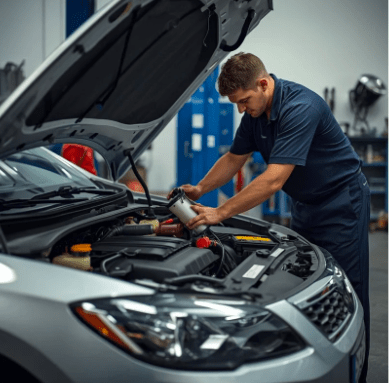
A professional wrong fuel recovery service can then:
- Safely drain the fuel tank
- Flush residual contamination
- Refill with the correct fuel
- Test the system
- Get you back on the road quickly
In many cases, the entire process takes less than an hour. More importantly, early intervention prevents damage rather than repairing it later.
A small fix vs a massive bill
Consider two real-world outcomes seen by Australian fuel recovery technicians.
First, a Melbourne driver realised she had added petrol to her diesel SUV before starting the engine. Instead of panicking, she called immediately.
Outcome:
- Tank drained and flushed
- Correct diesel added
- Vehicle tested and cleared
- Total time: 45 minutes
- Total cost: a few hundred dollars
By contrast, another driver misfuelled a diesel ute, started the engine, and drove approximately 10 kilometres before noticing power loss.
Outcome:
- Fuel pump failure
- Injector damage
- System-wide contamination
- Extended workshop labour
- Total repair cost: $5,200
The difference wasn’t luck. Instead, it was timing and action.
Hidden costs many drivers overlook
Misfuelling repair expenses extend well beyond parts and labour. In fact, many drivers face unexpected secondary costs, including:
- Emergency towing fees
- Diagnostic labour charges
- Hire car expenses
- Missed work or delayed deliveries
- Insurance excess payments
For commercial drivers, families, and long-distance travellers, these indirect costs often exceed the mechanical repairs themselves. Acting quickly helps avoid nearly all of them.
Why insurance rarely covers misfuelling?
Many drivers assume insurance will handle misfuelling repairs. Unfortunately, that’s rarely the case.
Most insurers classify misfuelling as driver error rather than an accident. As a result:
- Claims are frequently denied
- Repairs must be paid out of pocket
- Premiums may increase if a claim is attempted
Because of this, calling a professional wrong fuel recovery service immediately often costs far less than pursuing insurance.
What to do the moment you realise you’ve misfuelled?
If you suspect you’ve added the wrong fuel, act immediately:
- Do not start the engine
- If running, turn it off straight away
- Avoid DIY siphoning or fuel removal
- Call trained professionals immediately
Misfuelling itself does not have to be expensive. Delays are what turn small mistakes into major financial losses.
A fast response means:
- Minimal mechanical damage
- Lower repair costs
- Faster recovery
- Less stress
Professional help makes the difference
At Wrong Fuel Recovery & Mobile Mechanic, we specialise in fast, safe, and affordable wrong fuel recovery across Australia. Our mobile technicians respond quickly to prevent damage before it spreads.
Whether you’ve misfuelled moments ago or noticed symptoms shortly after leaving the pump, early intervention remains the key to protecting your vehicle.
Call Wrong Fuel Recovery & Mobile Mechanic at 0422 987 222 or book online for expert fuel drain and roadside assistance, anytime, anywhere in Australia.
A simple mistake does not have to cost thousands, but timing makes all the difference.