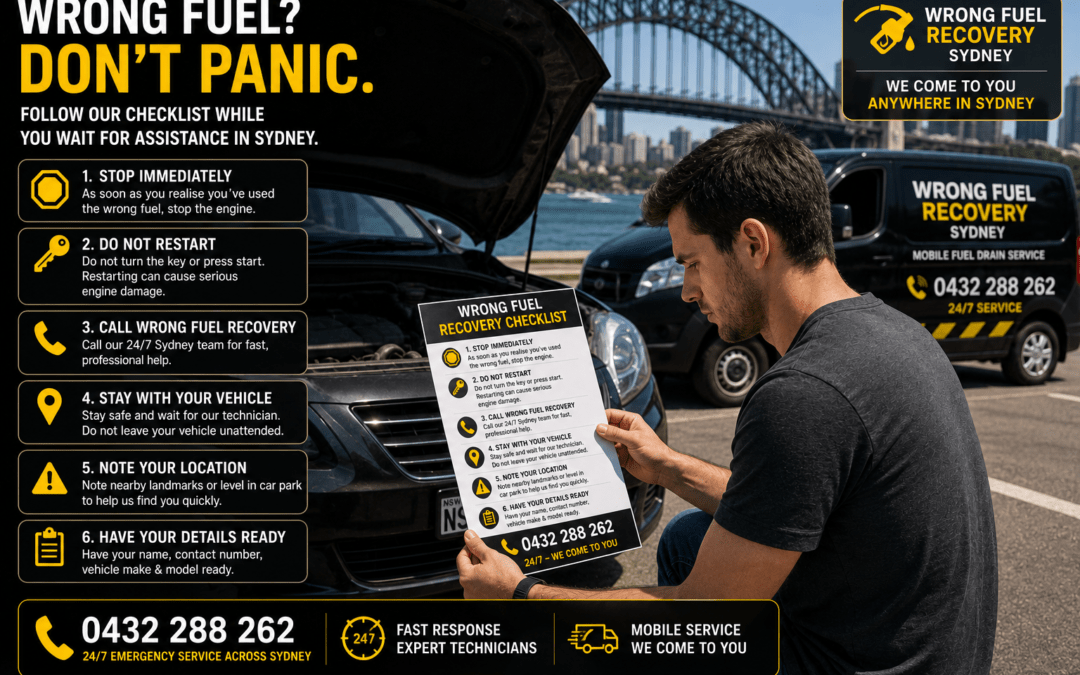
Follow this wrong fuel recovery checklist while waiting for help. Learn what information to prepare, what not to do and how to keep your vehicle safe.


Wrong Fuel Recovery Checklist: What to Do Before We Arrive

Realising that you have put the wrong fuel in your vehicle can be stressful, especially when you are blocking a petrol pump, parked on the roadside or trying to reach an appointment.

The actions you take while waiting for assistance can affect how complicated the recovery becomes.

The most important instruction is:

Do not start the engine or continue driving.

When the vehicle has not been started, most of the incorrect fuel may still be contained inside the tank. Switching on the ignition or starting the engine can move contaminated fuel farther through the system. RAC specifically advises drivers not to turn on the ignition after petrol has entered a diesel vehicle because the system may be primed and the recovery may become more complicated.

Use the following wrong fuel recovery checklist while waiting for professional assistance.


Quick wrong fuel recovery checklist

After discovering the mistake:

  1. Do not start or restart the engine.
  2. Leave the ignition completely off.
  3. Stop driving as soon as it is safe.
  4. Turn on your hazard lights when necessary.
  5. Tell service-station staff or property management.
  6. Keep the fuel receipt.
  7. Record the incorrect fuel and approximate amount added.
  8. Confirm whether the engine or ignition was activated.
  9. Send your exact location and access instructions.
  10. Provide the vehicle’s make, model and registration.
  11. Report any smoke, fuel leak, warning light or unusual noise.
  12. Keep your phone available and remain near a safe meeting point.
  13. Do not attempt to siphon or drain the tank yourself.
  14. Wait for the technician’s instructions before moving or restarting the vehicle.

Wrong Fuel Recovery & Mobile Mechanic advertises 24/7 service across Sydney and surrounding NSW suburbs and aims to attend within approximately 30–60 minutes depending on location. This is an estimated attendance period and may vary with traffic, access and technician availability.


1. Do not start the engine

Keeping the engine off is the most important part of the checklist.

When the incorrect fuel remains mainly inside the tank, a technician may be able to remove it before it circulates through additional components.

Do not start the vehicle to:

  • Move away from the petrol pump
  • Enter a nearby parking bay
  • Test whether the engine still works
  • Drive to a mechanic
  • Reach your home
  • Leave a shopping centre
  • Move onto a tow truck
  • Check whether a warning light disappears

Starting a diesel vehicle after petrol contamination may expose the fuel pump, filter, lines and injectors to the mixture. RAC advises that if the engine has already been started, it should be switched off immediately and the fuel system professionally drained and inspected.

2. Avoid switching on the ignition

Do not repeatedly turn the key or press the start button without starting the engine.

Depending on the vehicle, activating the ignition may prime parts of the fuel system. This could move contaminated fuel beyond the tank even though the engine never fully starts.

Also avoid unnecessarily operating:

  • Remote-start functions
  • Push-button starting systems
  • Hybrid READY mode
  • Automatic parking features
  • Vehicle preconditioning
  • Fuel-transfer switches
  • Auxiliary-tank pumps

Tell the technician whether the ignition was switched on, even when the engine did not run.

3. Stop driving safely

When you discover the mistake after leaving the service station, pull over as soon as it is safe.

Do not make a sudden stop in an active traffic lane. Find a suitable roadside area, shoulder, emergency stopping lane or breakdown lane where possible.

NSW Government breakdown guidance recommends parking as far to the left and away from traffic as possible, switching on the hazard lights and remaining protected from moving vehicles while calling for assistance.

Once safely stopped:

  • Switch the engine off.
  • Apply the parking brake.
  • Use hazard lights when appropriate.
  • Note your direction of travel.
  • Identify the nearest road, exit or landmark.
  • Do not repeatedly restart the engine.

4. Prioritise roadside safety

The fuel problem is important, but immediate traffic safety comes first.

When the vehicle is stopped on a busy road or motorway, tell the recovery provider:

  • Road name
  • Direction of travel
  • Nearest exit
  • Nearest cross street
  • Motorway marker or sign
  • Whether you are in a breakdown lane
  • Whether the vehicle is obstructing traffic
  • Whether passengers are present
  • Whether the location feels unsafe

Follow NSW road-safety instructions for your specific position. Official guidance generally recommends finding a safe place away from traffic, using hazard lights and calling roadside assistance.

A NSW traffic breakdown or hazard affecting traffic flow can be reported through the Incident Reporting Line on 131 700. Call 000 when someone has been injured or there is an immediate emergency.

Do not stand between the vehicle and moving traffic while waiting.

5. Tell the service-station staff

When you notice the mistake while still at the petrol station, inform the staff immediately.

Explain:

“I put the wrong fuel in my vehicle, and I cannot start the engine.”

Staff may be able to:

  • Temporarily close the affected pump
  • Direct other customers around your vehicle
  • Help identify the fuel selected
  • Confirm the pump number
  • Help arrange safe movement
  • Provide a suitable waiting area
  • Give the technician access instructions

Do not drive into a parking bay. When the vehicle must be moved, ask whether it can be pushed safely without activating the ignition.

Heavy utes, vans, trucks, vehicles on slopes and cars towing trailers may not be safe to push manually.

6. Keep the fuel receipt

Do not throw away the receipt.

It may confirm:

  • Fuel type
  • Fuel grade
  • Number of litres
  • Date and time
  • Service-station address
  • Pump number
  • Amount paid

Take a clear photograph of the receipt in case it becomes lost or damaged.

The information may help the technician assess the contamination. It may also support an insurance claim or discussion with the service station when contaminated fuel rather than driver error is suspected.

7. Confirm the correct and incorrect fuel

Before calling, identify:

  1. The fuel the vehicle normally requires
  2. The fuel or fluid that entered the tank

Common incidents include:

  • Petrol in a diesel vehicle
  • Diesel in a petrol vehicle
  • AdBlue in the diesel tank
  • Diesel in the AdBlue tank
  • Water-contaminated fuel
  • Incorrect petrol grade
  • Unknown fuel from a storage container

Check the:

  • Fuel-cap label
  • Fuel-door sticker
  • Owner’s manual
  • Service-station receipt
  • Pump label

Do not rely solely on nozzle colour because colours and product branding can differ between retailers. RAC notes that fuel colours and product names can vary between service-station brands.

8. Estimate how much incorrect fuel was added

The technician may ask for the approximate number of litres placed into the tank.

Provide your best estimate based on:

  • The receipt
  • The pump display
  • Amount paid
  • Starting fuel level
  • Current tank reading
  • Tank capacity

You do not need to calculate the exact percentage yourself.

A useful explanation is:

“The tank was approximately one-quarter full of diesel, and I added about 20 litres of petrol.”

Do not add more correct fuel to try to dilute the contamination unless a qualified technician or the vehicle manufacturer specifically instructs you to do so.

9. Be honest about whether the vehicle was started

The recovery provider needs an accurate sequence of events.

Tell them whether:

  • The key was turned
  • The start button was pressed
  • The ignition lights appeared
  • The engine started
  • The vehicle entered hybrid READY mode
  • The car was moved
  • The engine ran only briefly
  • The vehicle was driven
  • The vehicle stopped by itself
  • You attempted to restart it

Do not say the engine remained off simply because a hybrid vehicle was silent. A hybrid system can be active while the combustion engine is temporarily stopped.

Accurate information helps the technician determine what equipment, flushing or additional inspection may be necessary.

10. Record how far the vehicle was driven

When the vehicle was driven after misfuelling, estimate:

  • Distance travelled
  • Time the engine ran
  • Approximate speed
  • Whether the vehicle was towing
  • Whether it travelled uphill
  • When symptoms began

For example:

“I drove approximately four kilometres before the engine began losing power.”

The technician may recommend mobile drainage, additional flushing, towing or workshop inspection depending on what happened.

Do not continue driving to reduce inconvenience. The sooner the engine is switched off, the less opportunity there is for the contaminated fuel to circulate farther.

11. Report all warning signs

Tell the technician about every symptom, even when it appeared briefly.

Possible warning signs include:

  • Loss of power
  • Rough idling
  • Misfiring
  • Hesitation
  • Knocking noises
  • Excessive smoke
  • Engine warning light
  • Fuel-system warning
  • Water-in-fuel warning
  • Hybrid-system warning
  • Difficulty starting
  • Engine stalling
  • Strong fuel smell
  • Visible fuel leak

A technician cannot diagnose every mechanical problem by phone, but the symptoms help determine whether the vehicle may need workshop assessment rather than a simple tank drain.

12. Send your exact location

A complete address is better than only sending the suburb.

Provide:

Street address:
Suburb:
Postcode:
Nearest cross street:
Property or business name:
Parking level or bay:
Direction of travel:
Nearest landmark:

When possible, send a map pin through text message.

For large properties such as shopping centres, airports, hospitals and industrial sites, include:

  • Entrance name
  • Car-park level
  • Section colour
  • Bay number
  • Nearest lift
  • Security contact
  • Loading-dock access
  • Boom-gate instructions
  • Vehicle-height restriction

Accurate access details can reduce the time spent searching for the vehicle.

13. Provide complete vehicle information

Prepare:

  • Make
  • Model
  • Variant
  • Manufacturing year
  • Registration number
  • Body type
  • Petrol, diesel or hybrid
  • Engine type when known
  • Tank size when known
  • Vehicle colour

Also mention:

  • Long-range fuel tanks
  • Auxiliary tanks
  • Dual-tank systems
  • Aftermarket modifications
  • Trailer or caravan
  • Commercial load
  • Low-clearance bodywork
  • Locked or restricted parking

A model name by itself may not be enough because some models are sold with petrol, diesel and hybrid variants.

14. Tell us about parking and access restrictions

Before the technician travels, mention anything that could affect access.

Examples include:

  • Underground parking
  • Low clearance
  • Narrow driveway
  • Locked gate
  • Ticketed car park
  • Construction site
  • Secure workplace
  • Loading dock
  • Steep driveway
  • Soft or unstable ground
  • Busy roadside
  • Airport-controlled area
  • Ferry terminal
  • Remote property

The technician may need an access code, security approval or an alternative meeting point.

Do not drive the contaminated vehicle outside simply to make access easier. Ask the provider and property management how it should be moved.

15. Contact property management when required

When the vehicle is on private property, tell the relevant staff that a recovery technician is coming.

This may include:

  • Shopping-centre security
  • Workplace reception
  • Building management
  • Service-station staff
  • Hospital security
  • Airport parking staff
  • Construction-site supervisor
  • Hotel reception
  • Residential strata manager

Ask whether mobile fuel drainage is allowed in the current location.

An underground or enclosed parking area may require the vehicle to be moved or towed to a safer, better-ventilated space. Petrol vapours can travel along the ground and may ignite when they reach a spark, flame or other ignition source.

16. Keep the keys available

The technician may need access to:

  • Fuel cap
  • Vehicle interior
  • Bonnet
  • Boot
  • Fuel-pump area
  • Dashboard
  • Gear selector
  • Parking brake
  • Owner’s manual

Keep the keys with you, but do not use them to activate the ignition unless instructed.

When someone else owns the vehicle, make sure the owner or authorised driver is available to approve the work.

17. Keep your phone charged and available

Stay reachable after requesting assistance.

The technician may call to:

  • Confirm the location
  • Request a photograph
  • Ask about the vehicle
  • Explain an access delay
  • Identify the correct entrance
  • Confirm arrival
  • Provide safety instructions

Avoid placing the phone on silent.

When your battery is low, tell the dispatcher and provide an alternative contact number when possible.

18. Take useful photographs

Photographs may help the technician prepare before arrival.

Take pictures of:

  • Vehicle
  • Registration plate
  • Fuel-cap label
  • Pump used
  • Receipt
  • Dashboard warning
  • Parking location
  • Car-park height sign
  • Auxiliary fuel tank
  • Visible leak from a safe distance

Do not approach an active fuel spill merely to take a photograph.

19. Keep passengers safe and comfortable

Move passengers to a safe waiting place when appropriate.

Consider:

  • Children
  • Elderly passengers
  • People with disabilities
  • Pets
  • Extreme heat
  • Heavy rain
  • Roadside traffic
  • Lack of lighting

At a service station or shopping centre, one adult can remain contactable while other passengers wait somewhere safer.

Do not leave children, vulnerable passengers or pets unattended in the vehicle.

20. Do not attempt a DIY fuel drain

Do not try to remove the fuel using:

  • A garden hose
  • Mouth siphoning
  • Household pumps
  • Vacuum cleaners
  • Improvised containers
  • Drilling the tank
  • Disconnecting random fuel lines
  • Removing the fuel pump without training

RAC recommends that incorrect fuel be drained by a specialist because of the risks to people and the environment.

Petrol vapour is highly flammable and can travel to an ignition source some distance from the original spill.

Never pour contaminated fuel:

  • Onto the ground
  • Into stormwater drains
  • Into a toilet
  • Into household rubbish
  • Into an unapproved container

21. Do not smoke or create ignition sources

While waiting:

  • Do not smoke near the vehicle.
  • Keep flames away.
  • Do not use tools that create sparks.
  • Do not attempt electrical repairs.
  • Do not operate a generator beside the vehicle.
  • Do not drain fuel inside an enclosed garage.

When there is a visible leak, strong vapour, smoke or immediate danger, move people away and contact the property manager or emergency services.

Checklist for different locations

At a service station

  • Leave the engine and ignition off.
  • Tell the attendant.
  • Keep the receipt.
  • Note the pump number.
  • Ask whether the car can remain where it is.
  • Move it only by an approved safe method.
  • Send the station address and pump location.
  • Wait away from active vehicle movements.

At home

  • Keep the vehicle switched off.
  • Open the gate when safe.
  • Move other vehicles when they are blocking access.
  • Keep children and pets away from the work area.
  • Tell the technician about steep driveways or enclosed garages.
  • Do not attempt to siphon the tank before help arrives.

At work

  • Notify reception or security.
  • Obtain contractor access when required.
  • Give the technician the building, bay or loading-dock details.
  • Tell your fleet manager when it is a company vehicle.
  • Check whether work is permitted in the current parking area.
  • Keep company fuel-card and receipt records.

At a shopping centre

  • Contact centre security.
  • Give the level, section and bay number.
  • Confirm the clearance height.
  • Keep your parking ticket.
  • Do not drive towards the exit.
  • Ask whether drainage is permitted or towing is required.

On the roadside

  • Pull over only as far as necessary to reach safety.
  • Position the vehicle away from traffic where possible.
  • Use hazard lights.
  • Follow NSW breakdown-safety guidance.
  • Give the direction of travel and nearest exit.
  • Do not stand in an exposed traffic lane.
  • Report a hazardous traffic obstruction when necessary.

In a hybrid vehicle

  • Do not press the power button.
  • Do not activate READY mode.
  • Do not attempt to move using electric power.
  • Tell the technician whether the vehicle was activated.
  • Provide the exact hybrid or plug-in hybrid model.

In a ute, 4WD or commercial vehicle

  • Mention any long-range or auxiliary tank.
  • Do not use a tank-transfer pump.
  • Tell the provider about trailers, caravans or heavy loads.
  • Give the total vehicle dimensions when access is restricted.
  • Confirm whether the location can accommodate the service vehicle.

Information to send in one message

You can copy and complete this template:

Name:

Mobile number:

Exact location:

Vehicle registration:

Vehicle make and model:

Vehicle year or variant:

Correct fuel required:

Incorrect fuel added:

Approximate amount added:

Fuel already in the tank:

Ignition switched on? Yes/No

Engine started? Yes/No

Vehicle driven? Yes/No

Approximate distance driven:

Current symptoms or warning lights:

Parking or access instructions:

Trailer, auxiliary tank or modifications:

Sending complete information can help the technician assess the incident and arrive prepared.

What happens when the technician arrives?

The exact process depends on the vehicle and contamination, but the technician will generally begin by confirming:

  • Vehicle identity
  • Correct fuel type
  • Incorrect fuel type
  • Approximate quantity
  • Whether the engine was started
  • Whether the vehicle was driven
  • Current symptoms
  • Fuel-system accessibility
  • Whether on-site recovery is safe

The recovery may then involve:

  1. Securing the vehicle
  2. Accessing the fuel system
  3. Extracting the contaminated fuel
  4. Flushing relevant parts where necessary
  5. Adding clean, correct fuel
  6. Testing the vehicle
  7. Recommending further diagnostics or towing when needed

The company states that its technicians provide drainage, flushing and refuelling and can assist with cars, vans, trucks, motorbikes and fleet vehicles.

Do not restart or drive until the technician confirms that it is appropriate.

What should you prepare for payment or insurance?

Before work begins, ask:

  • What is included in the quote?
  • Is travel included?
  • Is replacement fuel included?
  • Are after-hours charges included?
  • Will towing cost extra?
  • Is a written report available?
  • Which payment methods are accepted?
  • Will an invoice be provided?

The business FAQ states that pricing depends on location and the service required and that the customer is informed of the cost before work starts.

When you intend to make an insurance claim, retain:

  • Fuel receipt
  • Photographs
  • Technician invoice
  • Recovery report
  • Towing invoice
  • Insurance claim reference
  • Details of any warning lights
  • Service-station correspondence

Only the insurer can confirm whether the incident is covered.

Common mistakes while waiting

Avoid these actions:

  • Starting the engine again
  • Turning on the ignition repeatedly
  • Driving a short distance to a mechanic
  • Adding more correct fuel
  • Using a fuel additive
  • Attempting to siphon the tank
  • Disconnecting fuel lines
  • Transferring fuel between tanks
  • Hiding that the vehicle was driven
  • Giving an incomplete address
  • Leaving your phone unanswered
  • Standing in a dangerous traffic area
  • Ignoring a visible leak
  • Smoking beside the vehicle

The safest approach is to keep the vehicle off, provide accurate information and follow professional instructions.

Frequently asked questions

What is the first thing I should do after putting in the wrong fuel?

Do not start the engine. When it has already started, switch it off as soon as it is safe and do not attempt another restart.

Can I move the vehicle away from the petrol pump?

Ask service-station staff and the recovery provider. The vehicle may sometimes be pushed into a safe bay, but it should not be moved by starting the engine.

What information does the technician need?

Provide your exact location, vehicle make and model, correct fuel, incorrect fuel, quantity added, whether the ignition or engine was activated and whether the vehicle was driven.

Should I keep the fuel receipt?

Yes. It helps confirm what fuel was purchased, how much was added and when the incident occurred.

Can I add more correct fuel to dilute the mistake?

Do not do so without vehicle-specific professional advice. Adding more fuel does not remove the contamination and may increase the quantity that eventually needs to be extracted.

Can I siphon the tank myself?

No. Fuel extraction involves flammable liquid and vapour, specialised equipment and safe containment. RAC recommends that drainage be performed by a specialist.

Should I call my insurer before the technician arrives?

Contact the insurer promptly when you intend to claim, but do not delay urgent safety action. Ask whether prior authorisation, particular providers or specific evidence is required.

What if I already drove the vehicle?

Stop safely, switch off the engine and tell the technician exactly how far you drove and what symptoms occurred. Additional flushing, towing or mechanical inspection may be necessary.

What if the vehicle is in an underground car park?

Give the parking level, clearance height, entrance and management contact details. On-site drainage may depend on ventilation, space, property permission and safety.

How quickly can assistance arrive?

Wrong Fuel Recovery & Mobile Mechanic states that it aims to attend within approximately 30–60 minutes depending on the customer’s location in Sydney and surrounding suburbs. Traffic and access may affect attendance.

Should I remain with the vehicle?

Remain nearby when it is safe, or provide a clear meeting location and stay reachable by phone. Do not wait in an exposed traffic area.

Can I drive after the fuel has been removed?

Only drive after the technician has completed the recovery and confirms that the vehicle appears safe to operate. Further inspection may be recommended when warning lights, smoke, rough running or unusual noises remain.

Need wrong fuel recovery in Sydney?

While waiting for help, remember the essentials:

  • Keep the engine and ignition off.
  • Stop driving.
  • Remain somewhere safe.
  • Keep the receipt.
  • Record what fuel was added.
  • Send your exact location.
  • Provide complete vehicle information.
  • Report all symptoms.
  • Do not attempt DIY drainage.
  • Follow the technician’s instructions.
                    Do not panic

                    Misfuelling can feel overwhelming, especially at a busy Sydney service station. Staying calm is crucial. Panic often leads to quick decisions like starting the engine to move the car or tapping the accelerator to “check” if it runs properly. Even a few seconds of operation can push contaminated fuel deeper into the system. Pause, breathe, and avoid making the situation worse.
                    Turn off the engine

                    If the engine has already been started, switch it off immediately. Do not restart it under any circumstances. Keeping the ignition completely off prevents the fuel pump from circulating contaminated fuel through the injectors and fuel lines. The less movement inside the system, the lower the risk of damage.

                    Call our team

                    Call Wrong Fuel Recovery & Mobile Mechanic or you can book online for immediate assistance. 

                    Relax and wait

                    Once help is on the way, there is nothing more you need to do. Our team at Wrong Fuel Recovery and Mobile Mechanic typically arrives quickly across Sydney and surrounding NSW suburbs. Using specialised equipment, they safely drain the contaminated fuel and refill your vehicle with the correct type, restoring normal operation without unnecessary stress on the engine.

                    Acting calmly and quickly makes all the difference. In most cases, these four simple steps turn a stressful moment into a manageable situation.

                    Across Sydney and surrounding suburbs in NSW, fast response is the key difference between a minor inconvenience and a costly repair. Timing truly is everything after misfuelling. The sooner the engine is switched off and contaminated fuel is removed, the greater the chance your vehicle returns to normal without lasting damage.

                    A small mistake at the pump does not have to become a long term problem. With prompt wrong fuel rescue, drivers across Sydney can protect their engines, reduce repair costs, and get back on the road with confidence.