
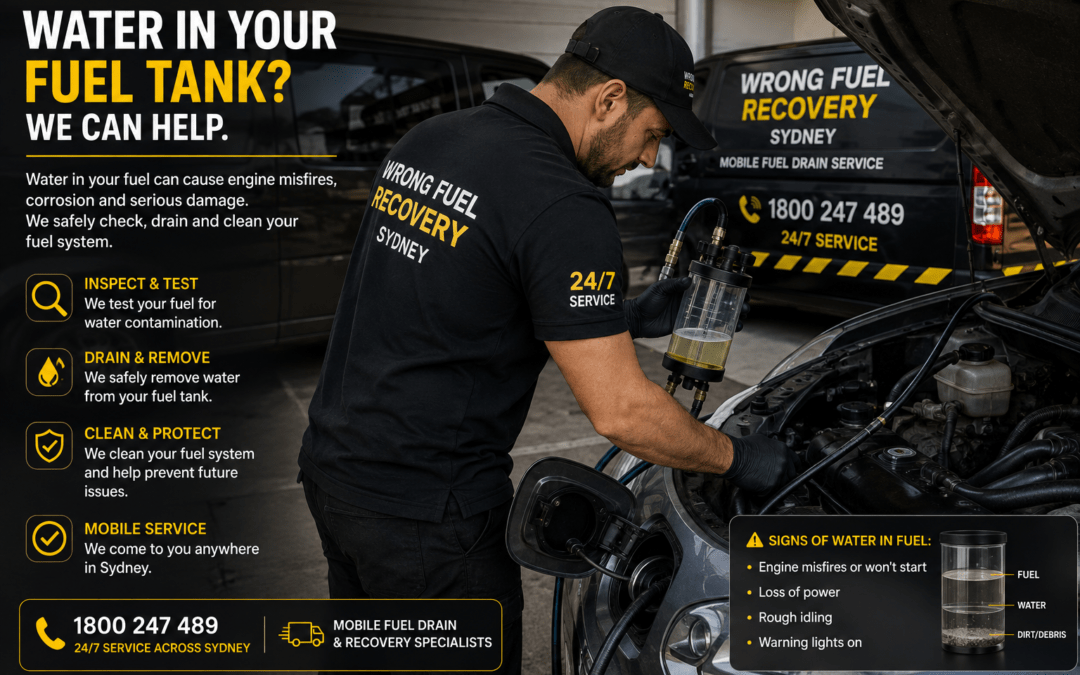
What Happens If Water Gets Into Your Fuel Tank?
Water in your fuel tank can cause serious problems.
However, the effects depend on the amount of water and the fuel type.
For example, water can cause rough running, stalling and poor engine performance.
In addition, it can cause corrosion inside the fuel system.
Therefore, you should act quickly if you suspect water contamination.
If the problem starts while driving, find a safe place to stop.
Then, switch the engine off.
After that, arrange professional assistance.
How Does Water Get Into a Fuel Tank?
Water can enter a fuel tank in several ways.
For example, contaminated fuel may come from a service station.
In addition, moisture can enter through damaged seals or fuel caps.
Condensation can also form inside a tank.
Therefore, water contamination can happen even when you use the correct fuel.
Contaminated Fuel From a Service Station
Water can enter underground fuel storage tanks.
For example, flooding or damaged equipment may allow water to enter.
As a result, contaminated fuel may reach a customer’s vehicle during refuelling.
However, similar symptoms can also come from other vehicle problems.
Therefore, professional testing is important before blaming a fuel station.
Condensation Inside the Tank
Moisture can also form naturally inside a fuel tank.
For example, warm air may enter the tank.
Then, that air can cool against the tank walls.
As a result, small amounts of water may form.
However, a large amount of water should not be ignored.
Therefore, investigate any signs of significant contamination.
Damaged Fuel Caps and Seals
A damaged fuel cap can allow water to enter the tank.
Similarly, cracked seals can create another entry point.
Therefore, inspect the filler area after heavy rain.
Check for:
- A loose fuel cap
- A cracked seal
- A damaged filler flap
- Water near the filler opening
- Signs of flood exposure
If you find damage, repair it as soon as possible.
Poorly Stored Fuel and Jerry Cans
Fuel containers can also introduce water.
For example, an old container may contain moisture, rust or dirt.
Therefore, only use containers that are suitable for fuel.
Also, keep every container clean and tightly sealed.
Never use a container that previously held water or unknown chemicals.
Flooding and Vehicle Submersion
Floodwater can enter several parts of a vehicle.
For example, it may reach the tank through damaged seals or vents.
In addition, floodwater can affect electrical and mechanical systems.
Therefore, do not restart a flood-damaged vehicle immediately.
Instead, arrange a full inspection first.
Long-Term Fuel Storage
Stored fuel can also develop contamination problems.
For example, temperature changes may allow moisture to collect.
In addition, old diesel can support microbial growth when water is present.
Therefore, stored vehicles need regular checks.
This is especially important for:
- Seasonal vehicles
- Boats
- Farm equipment
- Generators
- Motorhomes
- Backup vehicles
- Long-term stored cars
What Happens to Water Inside Petrol?
Water and petrol do not mix evenly.
Instead, free water can settle below the petrol.
However, ethanol-blended petrol behaves differently.
Ethanol can absorb some moisture.
Once too much water enters, phase separation may occur.
As a result, a water-and-ethanol layer may form.
Possible symptoms include:
- Hard starting
- Rough idling
- Hesitation
- Misfiring
- Stalling
- Poor combustion
- Warning lights
- Fuel-system corrosion
Therefore, do not continue driving if these symptoms begin after refuelling.
What Happens to Water Inside Diesel?
Diesel fuel systems can be very sensitive to water.
For example, modern diesel pumps work at very high pressures.
In addition, diesel injectors contain very small internal parts.
Water can contribute to:
- Corrosion
- Reduced lubrication
- Pump wear
- Injector wear
- Filter blockage
- Poor fuel delivery
- Microbial growth
Therefore, water in diesel should be taken seriously.
Symptoms of Water in a Fuel Tank
Water contamination can cause several symptoms.
However, these symptoms can also have other causes.
Common signs include:
- Hard starting
- Rough idling
- Jerking
- Hesitation
- Reduced acceleration
- Loss of power
- Misfiring
- Engine stalling
- Warning lights
- Unusual smoke
- Blocked fuel filters
- Poor fuel economy
The timing of the symptoms can also help.
For example, contamination may be more likely after recent refuelling.
It may also appear after heavy rain or flooding.
Similarly, problems may begin after using fuel from a jerry can.
Therefore, note when the symptoms first appeared.
What Does a Water-in-Fuel Warning Mean?
Some diesel vehicles have a water separator.
They may also have a warning sensor.
If the warning appears, check the owner’s manual.
Do not simply clear the warning and continue driving.
Instead, the separator may need draining.
The fuel filter may also need attention.
Therefore, follow the vehicle manufacturer’s instructions.
Can Water Damage the Fuel Pump and Injectors?
Yes.
Water can damage several fuel-system parts.
For example, it can cause corrosion.
It can also reduce lubrication in diesel systems.
As a result, pumps and injectors may wear faster.
In addition, water may carry rust and dirt through the system.
Therefore, early action can help reduce further contamination.
Corrosion
Water can cause metal parts to corrode.
For example, corrosion may develop inside the tank.
It may also affect fuel lines, pumps and injectors.
As a result, rust particles can enter the fuel.
Therefore, corrosion can create even more contamination.
Reduced Lubrication
Diesel helps lubricate some fuel-system components.
However, water does not provide the same protection.
Therefore, water can increase wear inside diesel systems.
This is especially important for high-pressure pumps and injectors.
Injector Problems
Modern injectors contain very small internal parts.
Therefore, contamination can affect their movement.
For example, dirt or corrosion may cause sticking.
As a result, the engine may run poorly.
Blocked Fuel Filters
Fuel filters can trap water and debris.
However, a heavily contaminated filter may become blocked.
Possible signs include:
- Poor acceleration
- Reduced power
- Stalling
- Hard starting
- Engine shutdown
Therefore, the filter may need inspection or replacement.
Microbial Contamination
Water inside diesel can support bacteria and fungi.
As a result, sludge and debris may form.
This material can then block filters.
Therefore, draining visible water may not solve every case.
The tank may also need cleaning.
Is Water in Diesel Worse Than Water in Petrol?
Both problems need attention.
However, the risks are different.
Water in Diesel
Possible problems include:
- Corrosion
- Reduced lubrication
- Injector wear
- Pump wear
- Microbial growth
- Blocked filters
- Loss of fuel pressure
Water in Petrol
Possible problems include:
- Poor combustion
- Phase separation
- Rough running
- Misfiring
- Stalling
- Corrosion
- Hard starting
Therefore, neither problem should be ignored.
What Should You Do When You Suspect Water Contamination?
Act as soon as possible.
First, find a safe place to stop.
Next, switch the engine off.
Then, avoid restarting the vehicle.
After that, arrange professional assistance.
If the vehicle is in a dangerous location, contact roadside assistance.
Keep the Fuel Receipt
Keep your fuel receipt after refuelling.
For example, it can show:
- Service station
- Pump number
- Fuel type
- Date
- Time
- Quantity
Also, take a photo of the receipt.
That way, you still have a copy if the paper fades.
Record the Symptoms
Write down what happened.
For example, record:
- When the problem started
- Distance travelled
- Warning lights
- Smoke
- Stalling
- Unusual noises
- Starting problems
In addition, take photos or videos when safe.
This information may help the technician.
Contact the Service Station
Contact the station if the problem started after refuelling.
However, stay factual.
Explain what happened and keep your receipt.
Also, record the name of the person you spoke with.
Do not publicly blame the station without evidence.
Instead, wait for professional testing.
What Information Should You Give the Technician?
Prepare your vehicle details before calling.
For example, provide:
- Vehicle make
- Vehicle model
- Petrol or diesel
- Exact location
- Where you bought the fuel
- Approximate litres added
- When the symptoms started
- Distance driven
- Warning lights
- Whether the vehicle still runs
Therefore, the technician can assess the situation faster.
How Is Water Removed From a Fuel Tank?
The exact process depends on the vehicle.
First, the technician may inspect the fuel.
Next, they may drain the contaminated tank.
Then, they may remove water and sediment.
In addition, they may inspect the fuel filter.
The process may also include:
- Cleaning the tank
- Replacing filters
- Flushing fuel lines
- Adding clean fuel
- Testing fuel pressure
- Testing engine operation
However, more serious cases may need workshop repairs.
Therefore, the same process does not apply to every vehicle.
Can a Fuel Additive Remove the Water?
Do not add an unknown treatment without advice.
Some products claim to remove water.
However, they may not suit every vehicle.
In addition, additives cannot repair damaged pumps or injectors.
They also cannot remove heavy contamination.
Therefore, professional fuel removal is safer when significant water is present.
Can You Drive the Water Out of the Tank?
No.
Driving can pull contaminated fuel deeper into the system.
For example, water may reach the:
- Fuel filter
- Fuel pump
- Fuel lines
- Fuel rail
- Injectors
- Engine
As a result, the risk of damage can increase.
Therefore, stop driving when it is safe.
Does the Entire Tank Need to Be Drained?
In many cases, a full drain may be needed.
This is because water can settle at the bottom of the tank.
However, the correct process depends on several factors.
These include:
- Fuel type
- Amount of water
- Tank design
- Ethanol content
- Whether the engine ran
- Distance driven
- Filter condition
- Rust
- Microbial growth
Therefore, the technician should assess each case separately.
Will the Car Need Towing?
Not always.
Mobile recovery may be possible when the vehicle is safely parked.
For example, mobile service may work when:
- The tank is accessible
- The engine stopped early
- There is no fuel leak
- The location is safe
- The vehicle can be serviced on site
However, towing may be better in some cases.
For example, towing may be needed when:
- The engine stopped while driving
- The vehicle will not restart
- Warning lights remain active
- Heavy smoke appears
- Pump damage is suspected
- The vehicle was flooded
- The location is unsafe
Therefore, the safest option depends on the vehicle.
How Long Does Water-Contamination Recovery Take?
There is no fixed recovery time.
For example, a simple fuel drain may take less time.
However, serious contamination may need more work.
The total time may include:
- Technician travel
- Fuel assessment
- Fuel removal
- Tank cleaning
- Filter inspection
- Flushing
- Refuelling
- Vehicle testing
Therefore, ask for an estimate after providing your vehicle details.
How Much Does Water-in-Fuel Recovery Cost?
The price can vary.
For example, the vehicle type can affect the cost.
In addition, the amount of contamination matters.
Other factors include:
- Vehicle make and model
- Petrol or diesel system
- Tank size
- Location
- Time of attendance
- Distance driven
- Filter replacement
- Tank cleaning
- Diagnostics
- Towing
- Damaged pumps or injectors
Therefore, avoid using one fixed price for every case.
Does Insurance Cover Water-Contaminated Fuel?
Insurance cover depends on the policy.
Therefore, contact your insurer directly.
Ask whether the policy covers:
- Contaminated fuel
- Fuel draining
- Resulting repairs
- Towing
- Diagnostic work
Also, ask whether an excess applies.
Finally, keep all receipts and reports.
How Can You Reduce the Risk of Water Contamination?
A few simple steps can help.
First, keep the fuel cap in good condition.
Next, replace damaged seals quickly.
Also, use clean and approved fuel containers.
In addition:
- Avoid unknown fuel containers.
- Keep fuel away from rain.
- Replace fuel filters on time.
- Service diesel water separators.
- Avoid storing fuel for too long.
- Inspect rarely used vehicles.
- Keep fuel receipts.
- Investigate warning lights early.
Therefore, good maintenance can reduce contamination risks.
Frequently Asked Questions
What Are the First Signs of Water in a Fuel Tank?
Common signs include rough running and hard starting.
In addition, the vehicle may hesitate or stall.
However, other problems can cause the same symptoms.
Therefore, professional diagnosis may be needed.
Can a Small Amount of Water Damage an Engine?
It can cause problems.
However, the outcome depends on the vehicle and fuel type.
Therefore, even small amounts should not be ignored.
Does Water Settle at the Bottom of the Tank?
Free water usually settles below petrol or diesel.
However, ethanol-blended petrol behaves differently.
Therefore, phase separation may occur when too much water enters.
Can I Simply Replace the Fuel Filter?
Not always.
A new filter may help.
However, water may still remain inside the tank or fuel lines.
Therefore, the whole fuel system may need assessment.
Can a Water Separator Handle All Contamination?
No.
A separator can remove some water.
However, it may not handle a heavily contaminated tank.
Therefore, follow the vehicle manufacturer’s maintenance instructions.
Does Adding Fresh Petrol or Diesel Fix the Problem?
No.
Adding more fuel only dilutes the contamination.
As a result, you may create more contaminated fuel.
Therefore, do not rely on dilution.
Can Water Cause Diesel Bug?
Yes.
Water can support microbial growth in diesel.
As a result, sludge and debris may develop.
Therefore, the tank may need extra cleaning.
What If the Problem Started After Refuelling?
First, stop driving when it is safe.
Next, keep the receipt.
Then, record the pump number and symptoms.
After that, contact the service station.
Finally, arrange professional fuel testing or recovery.
Can Water-Contaminated Fuel Be Removed On Site?
Yes, this may be possible.
However, the technician must check the vehicle and location.
Therefore, provide clear access details when you call.
Should a Flood-Damaged Vehicle Be Restarted?
No.
Floodwater can affect several vehicle systems.
Therefore, arrange a full inspection before restarting the vehicle.
Need Help With Water-Contaminated Fuel in Sydney?
Water in the fuel tank should not be ignored.
Therefore, stop driving when it is safe.
Then, switch the engine off.
Also, avoid adding unknown chemicals.
Keep your fuel receipt and record the symptoms.
Finally, arrange a professional fuel-system assessment.

Misfuelling can feel overwhelming, especially at a busy Sydney service station. Staying calm is crucial. Panic often leads to quick decisions like starting the engine to move the car or tapping the accelerator to “check” if it runs properly. Even a few seconds of operation can push contaminated fuel deeper into the system. Pause, breathe, and avoid making the situation worse.
If the engine has already been started, switch it off immediately. Do not restart it under any circumstances. Keeping the ignition completely off prevents the fuel pump from circulating contaminated fuel through the injectors and fuel lines. The less movement inside the system, the lower the risk of damage.

Call Wrong Fuel Recovery & Mobile Mechanic or you can book online for immediate assistance.

Once help is on the way, there is nothing more you need to do. Our team at Wrong Fuel Recovery and Mobile Mechanic typically arrives quickly across Sydney and surrounding NSW suburbs. Using specialised equipment, they safely drain the contaminated fuel and refill your vehicle with the correct type, restoring normal operation without unnecessary stress on the engine.
Acting calmly and quickly makes all the difference. In most cases, these four simple steps turn a stressful moment into a manageable situation.
Across Sydney and surrounding suburbs in NSW, fast response is the key difference between a minor inconvenience and a costly repair. Timing truly is everything after misfuelling. The sooner the engine is switched off and contaminated fuel is removed, the greater the chance your vehicle returns to normal without lasting damage.
A small mistake at the pump does not have to become a long term problem. With prompt wrong fuel rescue, drivers across Sydney can protect their engines, reduce repair costs, and get back on the road with confidence.