
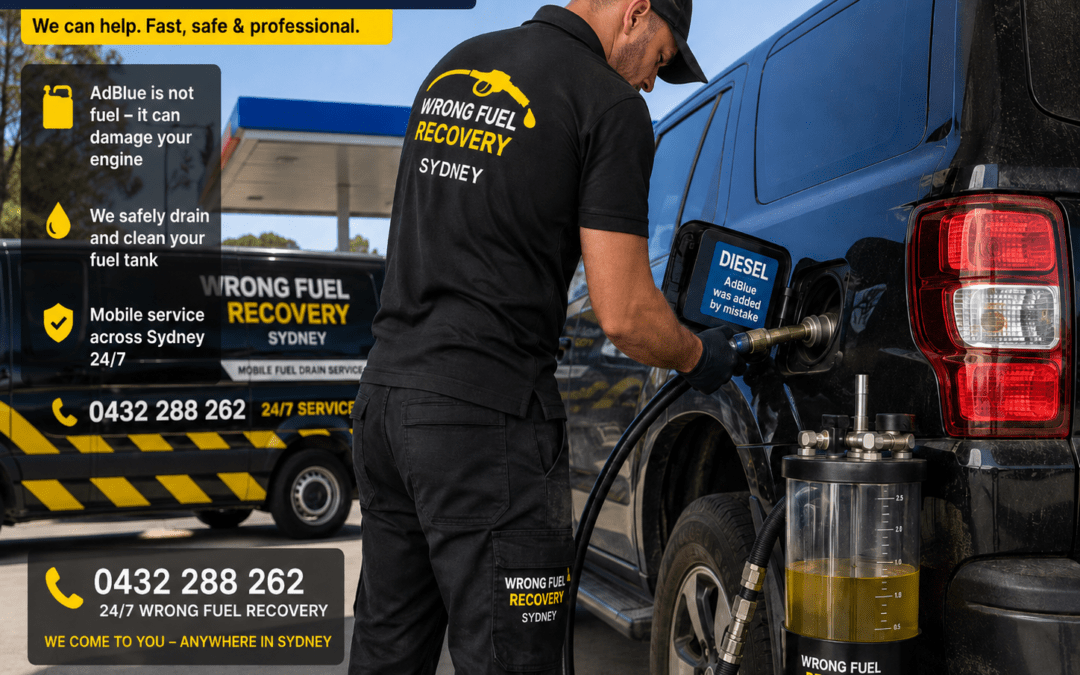
What Happens If You Put AdBlue in the Fuel Tank?
Putting AdBlue in a diesel fuel tank needs quick action.
However, the most important step is simple.
Do not start the engine.
AdBlue is not diesel.
Instead, it belongs in a separate exhaust-treatment system.
Therefore, keep the vehicle switched off.
Also, keep your receipt and record how much AdBlue you added.
Then, contact a professional recovery provider or roadside service.
What Is AdBlue?
AdBlue is also called diesel exhaust fluid or DEF.
It is used in many diesel vehicles.
However, it does not go into the diesel fuel tank.
Instead, the vehicle stores AdBlue in a separate tank.
During driving, the vehicle uses it in the exhaust system.
Therefore, AdBlue and diesel must stay separate.
A vehicle may have two different fillers:
- Diesel fuel filler
- AdBlue or DEF filler
The AdBlue filler may sit beside the diesel cap.
However, some vehicles place it under the bonnet or in another area.
Therefore, check the owner’s manual before filling.
Why Is AdBlue a Problem Inside the Diesel Tank?
AdBlue is not designed for the fuel system.
Therefore, it can contaminate diesel inside the tank.
If you start the engine, the mixture may enter the fuel system.
As a result, pumps, filters and injectors may be affected.
The exact risk depends on several factors.
For example:
- Amount of AdBlue added
- Amount of diesel already present
- Whether the engine started
- Whether the vehicle moved
- Fuel-system design
- How quickly the problem is fixed
Therefore, even a small amount should not be ignored.
Do not add more diesel to dilute it.
Instead, arrange professional advice.
What Should You Do Immediately?
If you notice the mistake, act as soon as possible.
First, keep the engine off.
Next, avoid turning the ignition on.
Then, tell the service-station staff.
After that, keep your receipt.
Also, record what happened.
Finally, contact a recovery provider.
Do Not Start the Engine
This is the most important step.
Starting the engine can move the mixture beyond the tank.
Therefore, leave the vehicle completely switched off.
Do not start it just to move away from the pump.
Instead, ask staff for help.
Avoid Switching the Vehicle On
Do not use the ignition unnecessarily.
Also, avoid pressing the start button.
Some vehicles may activate fuel-system parts before the engine starts.
Therefore, keep the vehicle fully off.
If you are unsure, wait for vehicle-specific advice.
Tell the Service-Station Staff
Explain what happened.
Tell them that AdBlue entered the diesel tank.
Also, explain that the vehicle must stay off.
Staff may help manage the area.
For example, they may help move the vehicle safely.
However, do not push a heavy vehicle unless it is safe.
Keep the Receipt
Your receipt can provide useful details.
For example, it may show:
- Product purchased
- Amount dispensed
- Time
- Service-station location
- Pump number
Therefore, keep the receipt.
Also, take a photo in case the paper is lost.
Record What Happened
Prepare your vehicle details before calling.
For example, record:
- Vehicle make
- Vehicle model
- Model year
- Engine type
- Amount of AdBlue added
- Diesel already in the tank
- Whether the ignition was switched on
- Whether the engine started
- Whether the vehicle moved
- Distance travelled
- Warning messages
- Exact location
This information helps the technician understand the problem.
Therefore, provide accurate details.
Tell the Technician It Is AdBlue
Be clear when you call.
For example, say:
“I accidentally put AdBlue into the diesel fuel tank.”
Do not describe it only as ordinary wrong fuel.
AdBlue contamination may require a different process.
Therefore, clear information is important.
What Happens If the Engine Was Not Started?
This is usually the better situation.
The contamination may still remain mainly inside the tank.
Therefore, the technician may have fewer areas to inspect.
A possible recovery process may include:
- Confirming what was added
- Checking the quantity
- Checking the vehicle design
- Draining the contaminated mixture
- Cleaning the tank if needed
- Inspecting the fuel system
- Replacing the filter if required
- Adding clean diesel
- Testing the vehicle
However, the exact process depends on the vehicle.
Therefore, follow the manufacturer or technician’s advice.
What Happens If You Started the Engine?
Stop the engine as soon as it is safe.
Then, do not restart it.
Also, tell the technician how long the engine ran.
This information matters.
Once the engine runs, the contamination may move farther.
Therefore, the technician may need to inspect more parts.
For example, work may include:
- Fuel tank drainage
- Tank cleaning
- Fuel-line checks
- Filter replacement
- Pump inspection
- Injector checks
- Diagnostic scanning
- Workshop testing
As a result, the vehicle may need more than a simple tank drain.
What If You Drove After Adding AdBlue?
Find a safe place to stop.
Then, switch the engine off.
After that, contact professional help.
Also, tell the technician:
- Distance travelled
- Loss of power
- Warning lights
- Stalling
- Restart problems
- Unusual noises
- Changes in engine performance
Do not continue driving because the car still feels normal.
A lack of symptoms does not prove the system is safe.
Therefore, stop and arrange assessment.
When Might Towing Be Needed?
Not every case needs a tow.
However, towing may be recommended in some situations.
For example:
- The vehicle was driven
- The engine stalled
- The vehicle will not restart
- Warning lights remain
- Fuel-system damage is suspected
- Workshop testing is required
- Mobile recovery is not suitable
Therefore, the safest option depends on the vehicle’s condition.
Can You Dilute AdBlue With More Diesel?
No.
Adding more diesel does not remove AdBlue.
Instead, it creates more contaminated fuel.
Therefore, do not fill the rest of the tank.
Also, do not attempt to drive the mixture through the engine.
The contamination should be removed.
Can You Siphon the Tank Yourself?
DIY draining is not recommended.
Several problems can occur.
For example:
- Incomplete fuel removal
- Fuel spills
- Unsafe containers
- Damage to the filler
- Damage to the tank
- Incorrect cleaning
- Early restarting
In addition, contaminated fuel needs safe handling.
Therefore, professional equipment is the safer option.
AdBlue in Diesel vs Diesel in AdBlue
These are different mistakes.
However, both need professional advice.
AdBlue in the Diesel Tank
This contaminates engine fuel.
Therefore, do not start the vehicle.
The fuel system may need drainage and cleaning.
Diesel in the AdBlue Tank
This contaminates the exhaust-treatment fluid.
As a result, the exhaust system may be affected.
Therefore, do not continue operating the vehicle.
Contact a qualified provider or authorised repairer.
How Can You Identify the Correct Filler?
Always check before adding fluid.
First, read the cap label.
Next, check the owner’s manual.
Then, look for words such as:
- Diesel
- Fuel
- DEF
- AdBlue
Also, do not rely only on cap colour.
Different vehicles place the fillers in different locations.
Therefore, always read the label.
Which Vehicles Use AdBlue?
Many modern diesel vehicles use AdBlue.
However, not every diesel vehicle needs it.
Vehicles that may use AdBlue include:
- Diesel passenger cars
- Four-wheel drives
- Diesel utes
- Commercial vans
- Trucks
- Buses
- Fleet vehicles
Therefore, check the individual vehicle.
Do not assume that every diesel has an AdBlue tank.
How Long Does AdBlue Recovery Take?
There is no fixed recovery time.
The process may be simpler if the engine stayed off.
However, it may take longer if the vehicle was driven.
Other factors include:
- Tank size
- Tank access
- Fuel filter condition
- Vehicle model
- Workshop testing
- Fuel-system inspection
The total process may include:
- Technician travel
- Vehicle assessment
- Fuel extraction
- Tank cleaning
- System inspection
- Clean refuelling
- Testing
Therefore, ask for an estimate after providing your vehicle details.
How Much Does AdBlue Recovery Cost?
The price can vary.
For example, vehicle type can affect the cost.
Other factors include:
- Tank capacity
- Amount of AdBlue
- Amount of diesel
- Whether the engine started
- Distance driven
- Filter replacement
- Fuel-system inspection
- Towing
- Workshop labour
- Location
- Call-out time
Therefore, avoid using one fixed price for every incident.
Your source also notes that AdBlue-specific pricing should be confirmed before publishing any exact business claim.
Can Insurance Cover AdBlue Contamination?
Insurance cover depends on the policy.
Therefore, contact your insurer directly.
Ask whether the policy covers:
- Accidental AdBlue contamination
- Fuel removal
- Resulting damage
- Towing
- Workshop repairs
Also, ask whether prior approval is needed.
Finally, keep all receipts and reports.
How Can You Prevent an AdBlue Mistake?
A few simple checks can help.
First, locate both filler caps.
Next, read every label.
Also, check the manual in an unfamiliar vehicle.
In addition:
- Do not refill while distracted.
- Do not rely only on cap colour.
- Use the correct AdBlue container.
- Keep AdBlue away from diesel containers.
- Label fleet fluids clearly.
- Train employees who refuel vehicles.
- Stop if you are unsure.
Therefore, always confirm the filler before pouring.
Frequently Asked Questions
Is AdBlue the Same as Diesel?
No.
AdBlue is a urea solution for the exhaust-treatment system.
Therefore, it must not go into the diesel tank.
What Should I Do First?
Do not start the engine.
Then, keep the vehicle off.
After that, contact a professional recovery provider or roadside service.
What If I Added Only a Small Amount?
Do not assume it is safe.
Instead, record how much you added.
Then, ask for vehicle-specific advice.
Can I Add Diesel and Keep Driving?
No.
Adding diesel does not remove the AdBlue.
Therefore, do not try to dilute the contamination.
Can a Mobile Technician Remove AdBlue?
It may be possible.
However, the provider needs suitable equipment.
Also, the exact vehicle must be supported.
Therefore, confirm AdBlue-specific capability before booking.
Will the Fuel Filter Need Replacing?
Possibly.
The answer depends on the vehicle.
It also depends on how far the contamination travelled.
Therefore, follow the technician’s advice.
Does the Vehicle Need Towing?
Not always.
However, towing may be recommended after driving or engine operation.
It may also be needed when workshop testing is required.
Can AdBlue Damage the Engine?
Yes, vehicle manufacturers warn about possible damage.
However, the risk depends on the quantity and how far the contamination travelled.
Therefore, quick action matters.
What If Diesel Went Into the AdBlue Tank?
Do not continue operating the vehicle.
Instead, contact an authorised repairer or qualified provider.
The exhaust-treatment system may need inspection.
Can I Clean the Tank Myself?
Professional help is recommended.
The mixture must be removed safely.
In addition, the tank may need cleaning.
Therefore, DIY work can create extra risks.
Need Help After Putting AdBlue in the Fuel Tank?
If AdBlue enters the diesel tank, keep the engine off.
Then, do not try to dilute the mixture.
Also, do not siphon the tank yourself.
Keep your receipt.
Next, record the amount added.
Finally, contact a professional recovery provider.

Misfuelling can feel overwhelming, especially at a busy Sydney service station. Staying calm is crucial. Panic often leads to quick decisions like starting the engine to move the car or tapping the accelerator to “check” if it runs properly. Even a few seconds of operation can push contaminated fuel deeper into the system. Pause, breathe, and avoid making the situation worse.

If the engine has already been started, switch it off immediately. Do not restart it under any circumstances. Keeping the ignition completely off prevents the fuel pump from circulating contaminated fuel through the injectors and fuel lines. The less movement inside the system, the lower the risk of damage.

Call Wrong Fuel Recovery & Mobile Mechanic or you can book online for immediate assistance.

Once help is on the way, there is nothing more you need to do. Our team at Wrong Fuel Recovery and Mobile Mechanic typically arrives quickly across Sydney and surrounding NSW suburbs. Using specialised equipment, they safely drain the contaminated fuel and refill your vehicle with the correct type, restoring normal operation without unnecessary stress on the engine.
Acting calmly and quickly makes all the difference. In most cases, these four simple steps turn a stressful moment into a manageable situation.
Across Sydney and surrounding suburbs in NSW, fast response is the key difference between a minor inconvenience and a costly repair. Timing truly is everything after misfuelling. The sooner the engine is switched off and contaminated fuel is removed, the greater the chance your vehicle returns to normal without lasting damage.
A small mistake at the pump does not have to become a long term problem. With prompt wrong fuel rescue, drivers across Sydney can protect their engines, reduce repair costs, and get back on the road with confidence.