
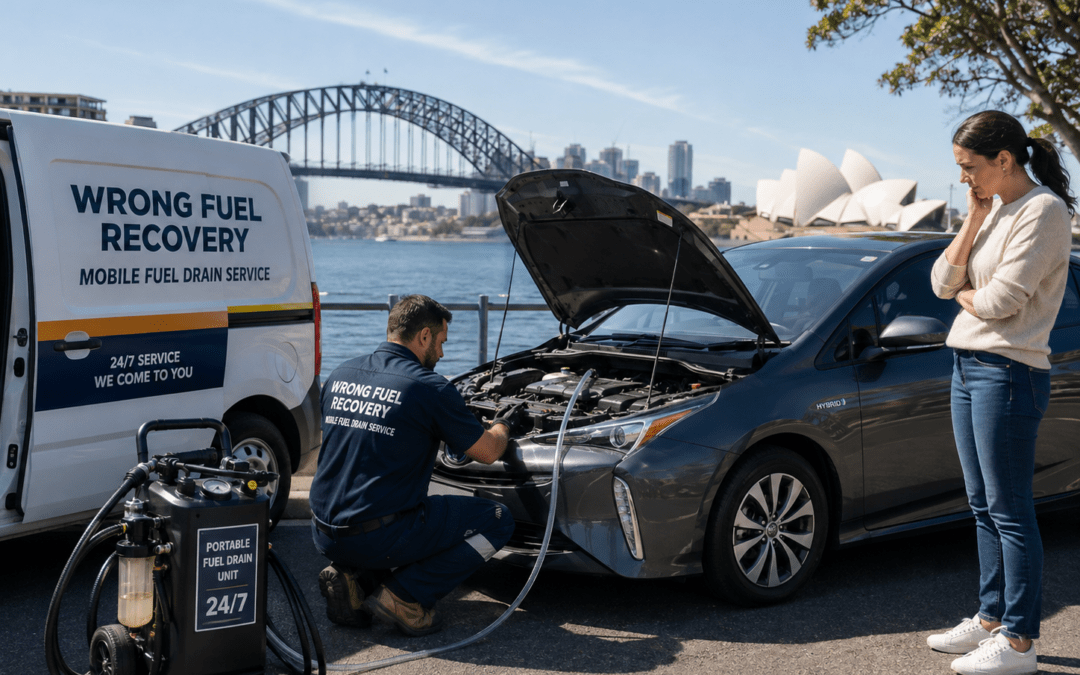
Wrong Fuel Recovery for Hybrid Cars: What Sydney Drivers Need to Know
Putting the wrong fuel in a hybrid can be confusing.
However, a hybrid still uses normal fuel.
For example, many hybrids have a petrol engine and a fuel tank.
Some hybrids may also use diesel.
Therefore, wrong fuel can still cause problems.
A hybrid may also stay quiet when switched on.
However, the engine can start automatically.
Therefore, do not assume silence means the engine is off.
What Should You Do After Putting Wrong Fuel in a Hybrid?
If you notice the mistake, act quickly.
First, do not press the power button.
Next, do not activate READY mode.
Then, do not try to drive using EV mode.
Also, keep the vehicle stationary.
After that, tell service-station staff if needed.
Finally, contact a wrong fuel recovery service.
Keep your fuel receipt.
Also, record the wrong fuel type and amount.
If READY mode was already active, tell the technician.
This detail is important even if you did not hear the engine.
Why Are Hybrid Cars Different?
A normal car usually makes engine operation obvious.
However, a hybrid can stay quiet.
The electric motor may move the vehicle first.
Then, the combustion engine may start automatically.
For example, the engine may start because of:
- Battery charge
- Acceleration
- Vehicle speed
- Heating
- Air conditioning
- Hybrid-system temperature
- Driving conditions
Therefore, you cannot guarantee that the engine will stay off.
Because of this, keep the whole hybrid system switched off.
Can You Drive a Hybrid on Battery Power?
No.
Do not try to drive in EV mode after misfuelling.
The car may initially move without engine noise.
However, the engine may start without warning.
As a result, contaminated fuel may enter the fuel system.
In addition, the car could stop once battery-only driving ends.
Therefore, leave the vehicle switched off.
Then, arrange professional assistance.
Which Hybrid Vehicles Can Be Misfuelled?
The advice applies to vehicles with an engine and electric motor.
However, different hybrid systems work in different ways.
Hybrid Electric Vehicles
A hybrid electric vehicle uses both an engine and electric motor.
Its battery normally charges while driving.
However, the vehicle still uses petrol or diesel.
Therefore, wrong fuel can affect the engine and fuel system.
Plug-In Hybrid Vehicles
A plug-in hybrid has a larger battery.
You can charge that battery from an external power source.
However, the vehicle still has a combustion engine.
Therefore, it still needs the correct fuel.
Do not assume a charged battery makes misfuelling safe.
Mild-Hybrid Vehicles
A mild hybrid uses electrical assistance.
However, it mainly depends on the combustion engine.
Therefore, treat wrong fuel like a normal petrol or diesel misfuelling incident.
Battery-Electric Vehicles
A fully electric vehicle has no normal fuel tank.
Therefore, this article does not apply to a pure EV.
Always check the exact vehicle type first.
What Happens if Diesel Goes Into a Petrol Hybrid?
Many hybrid passenger cars use petrol engines.
Therefore, diesel can be the wrong fuel.
Possible signs include:
- Rough running
- Misfiring
- Smoke
- Loss of power
- Hard starting
- Warning lights
- Reduced power
- Engine shutdown
However, the electric motor may hide some early symptoms.
Therefore, do not assume the vehicle is fine.
Switch the hybrid system off.
Then, arrange professional help.
What Happens if Petrol Goes Into a Diesel Hybrid?
Diesel hybrids are less common.
However, some vehicles use diesel hybrid systems.
Petrol can reduce the lubrication provided by diesel.
As a result, pumps and injectors may be affected.
If the vehicle stayed off, drainage may be simpler.
However, more work may be needed after READY mode or engine operation.
Therefore, tell the technician exactly what happened.
What About the Wrong Petrol Grade?
Using the wrong petrol grade is different from diesel contamination.
For example, using 95 RON instead of 91 RON is not the same problem.
However, using fuel below the required grade may create other issues.
Therefore, always follow the fuel label or owner’s manual.
Other fuel mistakes may include:
- Wrong ethanol blend
- AdBlue in the fuel tank
- Contaminated fuel
- Water in the tank
- Other fluids in the tank
If you are unsure, keep the hybrid off.
Then, contact the manufacturer or technician.
Does Wrong Fuel Damage the Hybrid Battery?
Usually, wrong fuel affects the combustion side first.
Fuel does not normally enter the high-voltage battery.
However, engine problems may trigger hybrid warnings.
Therefore, a dashboard warning does not always mean battery damage.
It may still require diagnostic testing.
Do not inspect the high-voltage battery yourself.
Hybrid High-Voltage Safety
Hybrid cars contain high-voltage parts.
Therefore, avoid touching hybrid electrical components.
Do not:
- Open hybrid battery covers
- Disconnect orange cables
- Touch high-voltage connectors
- Use isolation switches
- Dismantle hybrid components
- Allow unqualified people to work on the system
Fuel recovery should focus on the fuel system.
However, high-voltage work needs trained personnel.
How Does Hybrid Wrong Fuel Recovery Work?
The process depends on the vehicle.
However, several steps are common.
1. Identify the Vehicle
The technician needs the exact vehicle details.
For example, provide:
- Manufacturer
- Model
- Variant
- Year
- Registration
- Hybrid type
- Correct fuel
- Wrong fuel added
Therefore, do not provide only the model name.
2. Confirm Whether READY Mode Was Used
Tell the technician whether:
- The power button was pressed
- READY mode appeared
- The engine started
- EV mode was selected
- The vehicle moved
- Warning lights appeared
A silent hybrid may still be active.
Therefore, READY mode information is very important.
3. Access the Fuel System Safely
Tank access can vary between vehicles.
For example, some hybrids have:
- Anti-siphon fillers
- Internal fuel pumps
- Unusual tank shapes
- Limited access points
- Model-specific procedures
Therefore, the technician must check the exact vehicle.
4. Remove the Wrong Fuel
The technician may extract the contaminated fuel.
They should use proper fuel-safe equipment.
Therefore, do not siphon the tank yourself.
5. Flush Affected Parts
Some vehicles may need flushing.
However, the amount of work depends on the incident.
Important factors include:
- READY mode use
- Engine operation
- Distance driven
- Fuel type
- Wrong fuel amount
- Symptoms
- Vehicle design
Therefore, every case is different.
6. Add the Correct Fuel
After removing the wrong fuel, clean fuel can be added.
However, the fuel must match manufacturer requirements.
Therefore, confirm the correct fuel first.
7. Test the Hybrid
The technician may check:
- READY operation
- Engine starting
- Warning lights
- Misfiring
- Smoke
- Rough running
- Unusual noises
- Hybrid warnings
If problems remain, workshop inspection may be needed.
When Might a Hybrid Need Towing?
Mobile recovery may work for simple cases.
However, towing may be safer in some situations.
For example:
- The vehicle travelled a long distance
- The engine stopped
- Hybrid warnings remain
- READY mode does not work correctly
- Fuel is leaking
- The vehicle is unsafe
- The tank is damaged
- High-voltage inspection is needed
- Special diagnostics are required
Therefore, do not repeatedly press the power button.
Repeated attempts may create more problems.
Is Mobile Fuel Drainage Suitable for Every Hybrid?
No.
Not every hybrid can be handled the same way.
For example, suitability depends on:
- Vehicle model
- Hybrid design
- Tank access
- Wrong fuel type
- Amount added
- Engine operation
- Distance driven
- Warning lights
- Location
- Technician equipment
Therefore, confirm that the provider supports your exact hybrid.
How Long Does Hybrid Wrong Fuel Recovery Take?
There is no fixed time.
A simple drain may be faster.
However, hybrid checks can add time.
The total process may include:
- Technician travel
- Vehicle assessment
- System shutdown checks
- Fuel extraction
- Flushing
- Clean refuelling
- Testing
Therefore, ask for an estimate after sharing your vehicle details.
How Much Does Hybrid Wrong Fuel Recovery Cost?
The price depends on the incident.
For example, cost factors may include:
- Vehicle make
- Vehicle model
- Hybrid type
- Tank size
- Wrong fuel amount
- Tank access
- READY mode use
- Engine operation
- Distance driven
- Location
- Towing
- Diagnostics
Therefore, ask for a vehicle-specific quote.
How Can Hybrid Owners Avoid Misfuelling?
A few simple habits can help.
First, check the fuel-cap label.
Next, confirm the correct fuel type.
Also, read the pump label.
Do not rely only on nozzle colour.
If you drive a rental car, take extra care.
Similarly, check borrowed vehicles before refuelling.
In addition, remember that not every hybrid uses the same fuel.
Finally, use a fuel reminder if you manage several vehicles.
Therefore, always check before filling.
Frequently Asked Questions
Can a Hybrid Car Be Drained After Wrong Fuel?
Yes, many cases may be suitable for fuel drainage.
However, the exact vehicle must be checked first.
Therefore, tell the technician the full make, model and year.
Can I Drive in EV Mode After Misfuelling?
No.
The combustion engine may start automatically.
Therefore, keep the vehicle switched off.
Does Pressing the Power Button Count?
It can.
Pressing the button may activate READY mode.
Therefore, tell the technician if you pressed it.
Can I Drive a Plug-In Hybrid With a Full Battery?
No.
The combustion engine may still start automatically.
Therefore, a full battery does not make driving safe.
Will Wrong Fuel Destroy the Hybrid Battery?
Wrong fuel mainly affects the combustion fuel system.
However, engine problems may trigger hybrid warnings.
Therefore, proper diagnosis may still be needed.
Should I Disconnect the Hybrid Battery?
No.
Do not touch high-voltage components.
Therefore, leave battery work to trained technicians.
Can Mobile Recovery Work in an Underground Car Park?
Possibly.
However, access and ventilation matter.
Height limits may also affect the service.
Therefore, provide exact parking details.
Should the Hybrid Go to a Dealer?
It may need dealer or specialist inspection.
For example, this may happen when warnings remain.
It may also be needed after long-distance driving.
Therefore, follow the technician’s recommendation.
Are Toyota, Kia and Hyundai Hybrids Treated the Same?
The basic rule is similar.
However, fuel-system layouts vary.
Therefore, always provide the exact model and year.
Need Hybrid Wrong Fuel Recovery in Sydney?
A hybrid can stay silent while still being active.
Therefore, do not rely on engine noise.
If you put in the wrong fuel:
- Do not press the power button
- Do not activate READY mode
- Do not drive in EV mode
- Do not touch high-voltage parts
- Keep the fuel receipt
- Record the fuel type and amount
- Contact a professional recovery provider

Misfuelling can feel overwhelming, especially at a busy Sydney service station. Staying calm is crucial. Panic often leads to quick decisions like starting the engine to move the car or tapping the accelerator to “check” if it runs properly. Even a few seconds of operation can push contaminated fuel deeper into the system. Pause, breathe, and avoid making the situation worse.
If the engine has already been started, switch it off immediately. Do not restart it under any circumstances. Keeping the ignition completely off prevents the fuel pump from circulating contaminated fuel through the injectors and fuel lines. The less movement inside the system, the lower the risk of damage.

Call Wrong Fuel Recovery & Mobile Mechanic or you can book online for immediate assistance.

Once help is on the way, there is nothing more you need to do. Our team at Wrong Fuel Recovery and Mobile Mechanic typically arrives quickly across Sydney and surrounding NSW suburbs. Using specialised equipment, they safely drain the contaminated fuel and refill your vehicle with the correct type, restoring normal operation without unnecessary stress on the engine.
Acting calmly and quickly makes all the difference. In most cases, these four simple steps turn a stressful moment into a manageable situation.
Across Sydney and surrounding suburbs in NSW, fast response is the key difference between a minor inconvenience and a costly repair. Timing truly is everything after misfuelling. The sooner the engine is switched off and contaminated fuel is removed, the greater the chance your vehicle returns to normal without lasting damage.
A small mistake at the pump does not have to become a long term problem. With prompt wrong fuel rescue, drivers across Sydney can protect their engines, reduce repair costs, and get back on the road with confidence.